There is a particular quality to the nap you take after a hard ride that has no equivalent anywhere else in human experience. It is not the same as being tired. It is not the same as being lazy. It is something specific and earned - a state of physical resolution that the body enters only after it has been asked to give something real, and has given it.
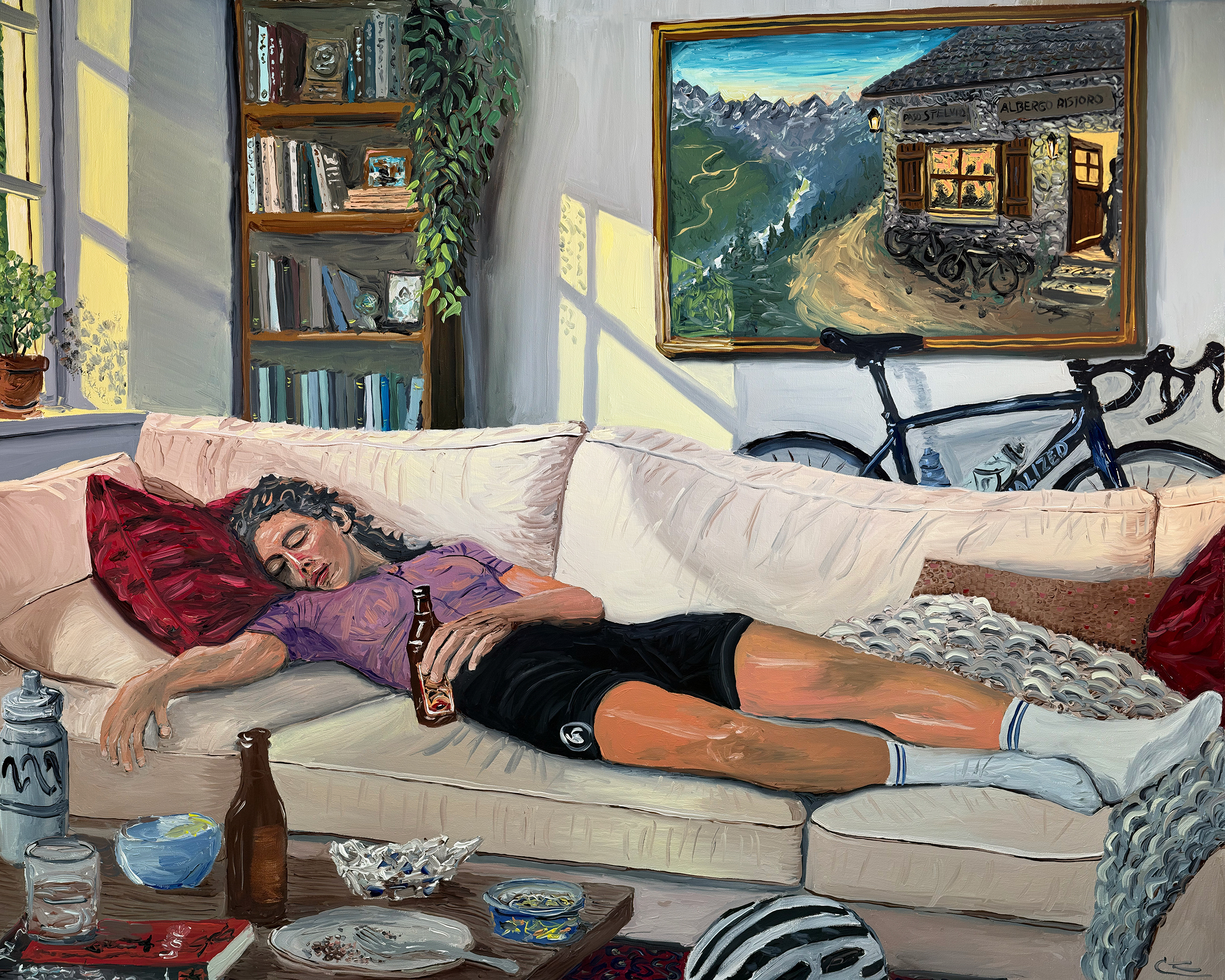
This painting is about that feeling. It is called Couch Theory.
The Theory Itself
The idea is simple enough to state and difficult to argue against: comfort is not an absolute value. It is a relative one. The quality of rest you experience is proportional to the effort that preceded it. A nap after four hours in the saddle and ten thousand feet of climbing is a different category of experience from a nap taken on an idle afternoon - not merely more pleasurable, but more meaningful. More deserved, in the deepest sense of that word.
Cyclists understand this intuitively. You finish a long ride and you come inside and you eat something impractical and you lie down, and the sofa receives you in a way that it simply does not on other days. Your legs feel heavy in a way that is not unpleasant. The room is warm. The afternoon light is moving across the ceiling. The bike is leaning against the wall still in its road grime because you did not have the energy or the inclination to clean it yet, and that is fine, because the cleaning can wait and this cannot.
What cannot wait is this specific moment, this specific quality of being physically spent in a context that is entirely safe and warm and yours. The beer helps. The food on the coffee table - the evidence of having eaten whatever was available and eaten it quickly and without ceremony - is part of it too. The cycling kit is still on because changing required a level of organisation that was not accessible.
You are not asleep yet. You are not quite awake. You are somewhere between the two, in a state that the body manufactures out of the raw material of effort, and it is one of the better places a person can be.
The Light
The light in Couch Theory is doing most of the painting's emotional work, and it is doing it quietly.
It is afternoon light - specifically the kind of late afternoon light that comes through a window at a low angle and lays itself across a room in long, warm panels. It catches the arm of the sofa. It flattens against the wall. It touches the yellow and cream tones of the room and makes them warmer than they would be at other hours of the day.
This is the light of completion. The ride was this morning, or this morning and into the afternoon, and now it is later and the light has moved and the day has a different quality. The urgency that governed the earlier hours - the alarm, the kit, the nutrition, the route - has dissolved. What remains is a room full of soft, angled light and a person at complete rest inside it.
The shadows on the wall behind the sofa are painted with the same attention as the figure. They are not background. They are evidence - of the hour, of the season, of the particular angle of the sun through that particular window on that particular afternoon. The painting knows what time it is.
This is what oil paint does well when it is used for this kind of subject. Vermeer knew it. Hopper knew it. Domestic light, painted in oil, carries a weight and a specificity that places the viewer in the room as much as in front of the canvas. You know this light. You have been in rooms with this light. The painting returns you there.
The Painting Within the Painting
Look at the wall above the sofa. There is a painting there - framed in gold, substantial in scale, demanding attention even as the figure below it sleeps.
It shows a mountain pass. Switchbacks cutting across a grey-green slope. A stone building at the roadside - Albergo Ristoro, refuge and restaurant - with bicycles leaning against its wall. Snow on the peaks above. The sky over the mountains the specific blue of high altitude on a clear day.
This is the Passo dello Stelvio. And the painting within the painting is not decorative. It is a promise.
The Stelvio
The Stelvio Pass sits at 2,757 metres above sea level in the Italian Alps, on the border between Lombardy and South Tyrol. Its eastern ascent from Bormio climbs 1,808 metres over approximately 24 kilometres, with 48 numbered hairpin bends cut into the mountainside in a sequence so regular and so steep that aerial photographs look like engineering diagrams rather than geography.
It is the second-highest paved mountain pass in the Alps. In the context of road cycling, it is simply one of the great climbs of the world.
The Giro d'Italia has used the Stelvio as its Cima Coppi - the race's highest point, named for Fausto Coppi - more than any other climb. The list of riders who have made history on its roads reads like a compressed account of professional cycling's greatest decades. Coppi himself attacked on the Stelvio in 1953 in weather that should have stopped the stage, riding alone through sleet and cloud to build a lead that ended the race as a contest. Marco Pantani danced up it in the late 1990s with a cadence that seemed to defy the gradient. Vincenzo Nibali, in front of his home crowd, sealed a Giro on its slopes in 2013.
But the Stelvio is not only a professional racing venue. It is a pilgrimage site for amateur cyclists from across the world - one of the designated goals that a certain kind of rider works toward for years, builds fitness for, travels to, and carries with them afterwards. To say you have climbed the Stelvio is to say something specific about what you are willing to do on a bicycle.
The study on the wall of Couch Theory is a preparatory painting for a larger work in this series - a full treatment of the Stelvio that will take the pass as its subject in the way the other paintings in the collection have taken their subjects: with attention to the history, the geography, the specific quality of light on a specific kind of terrain, and the human figure moving through all of it.
That painting is coming. The study is a marker, a commitment, a direction of travel.
Why We Ride
The presence of the Stelvio study above the sleeping cyclist is not accidental. It makes the painting's argument explicit.
The cyclist on the sofa has done something today - something hard enough that their body has shut down in the middle of the afternoon, beer in hand, kit unchanged, shoes still on. They earned this rest. And above them, on the wall, is the reason why - or at least one version of it. The pass. The mountain. The thing that requires this kind of preparation and this kind of commitment and produces, as a byproduct, this kind of exhausted, specific, irreplaceable rest.
We ride, ultimately, not for fitness metrics or for racing results or for the social ritual of the Saturday group ride, though these are all real and all good. We ride because the bicycle takes us into a relationship with our own physical limits that is both demanding and, in the right conditions, deeply satisfying. We ride because the effort produces states of body and mind that are available in no other way. We ride because the Stelvio exists, and because it is possible to get there under your own power, and because that fact means something.
And we ride because after you come home from a ride that asked you for something real, the sofa is there. The light is there. The particular quality of that afternoon rest is there, waiting for you, earned.
Couch Theory is a painting about cycling that contains almost no cycling. That is the point.
About the Painting
This work is an original oil on canvas, 60 inches wide by 48 inches tall, completed on May 8, 2026. It is part of The Golden Age Series by Christopher Watson - an ongoing body of work exploring cycling, endurance, and the human experience of the sport. Where many works in the series look outward at the races, the roads, and the history, Couch Theory looks inward. It is about the interior life of a cyclist: the domestic spaces the sport occupies, the way a hard ride reshapes an ordinary afternoon, and the particular quality of rest that effort makes possible.
The painting within the painting - the Stelvio study above the sofa - is a preparatory work for a future canvas in this series. The Passo dello Stelvio, with its 48 switchbacks and its 2,757-metre summit, is one of the great cycling climbs of the world and one of the defining locations in Giro d'Italia history. That painting is in progress. Couch Theory is, among other things, the moment before it.
Christopher Watson is a self-taught oil painter based in Peterborough, New Hampshire. He is a software engineer and endurance athlete with twelve Ironman finishes - someone who understands the couch theory not as a concept but as a regular lived experience. He began painting seriously in 2024, and cycling is his sole subject. The work is oil on canvas, made by hand, one painting at a time.
The original is available for private inquiry. Fine art archival prints in multiple sizes are available through the Velo Paintings print shop. If this painting captures something you recognise from your own riding life, it belongs on your wall.