Some ideas require two paintings to complete.
Girl on a Bridge - Day and Girl on a Bridge - Night are the only diptych in the Golden Age of Cycling series - two canvases conceived as a single work, painted to hang together, and designed so that each one changes in meaning when the other is present. This is the story behind both of them.
The Same Moment, Twice
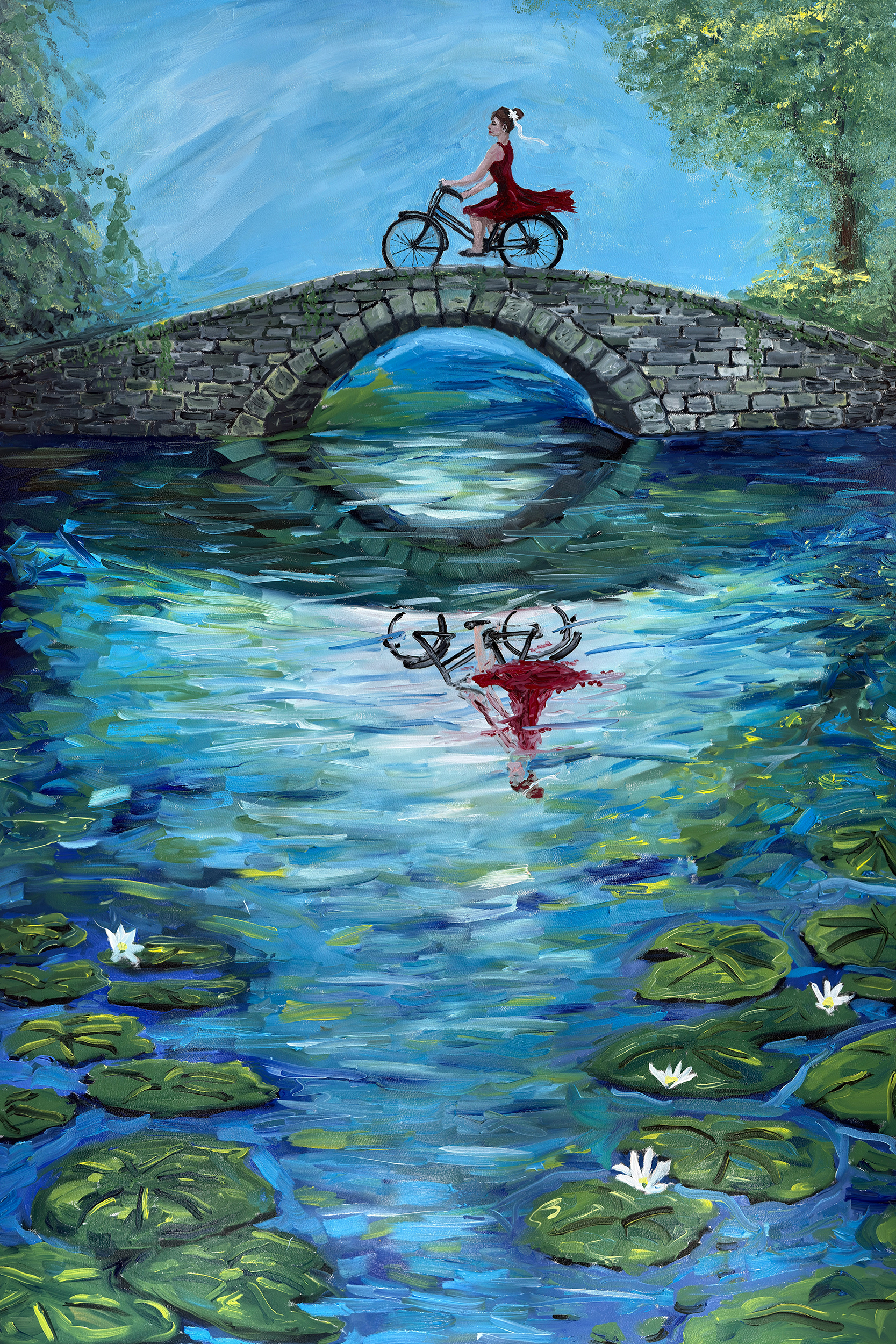
The composition is identical. The stone arch bridge. The lily pond below. The woman in the red dress on the black bicycle, crossing from one side to the other. The reflection in the water beneath her.
Everything is the same except the light - and because the light is different, everything is different.
In the Day painting, it is summer afternoon. The sky is blue and clear. The trees on the bank are full and green. The water below the bridge catches the light and holds it, turning the pond surface into something luminous and alive. The woman's reflection is sharp, her red dress vivid in the water, the bicycle's geometry precise and clear. The world is legible, present, warm.
In the Night painting, the same scene has transformed. The sky is deep cobalt, churning with the same Van Gogh-influenced brushwork that runs through several works in this series - swirling, textured, alive with movement. A crescent moon sits in the upper left. The tree that was full and green in the daylight version has become bare, its branches reaching into the night sky. The water beneath the bridge is darker, deeper, the reflection of the woman and her bicycle dissolved into something more suggestion than image. She is still there, still crossing, but the night has changed what that crossing means.
Monet and the Water Garden
The lily pond is not accidental. Anyone who has spent time with the history of Western painting will recognise what these canvases are in conversation with.
Claude Monet moved to Giverny in 1883 and spent the rest of his life there. In 1893 he purchased a piece of land adjacent to his property, diverted a small stream, and created a water garden - a pond surrounded by willows and flowering plants, with a Japanese-style footbridge crossing it at one end. He painted this garden obsessively for the final three decades of his life. The water lilies series alone comprises more than 250 paintings. The bridge appears in dozens more.
Monet's great subject was not the garden itself but the light on the garden - the way a familiar scene transforms across the hours of the day and the seasons of the year, so that what you are really painting is not a pond but the quality of perception itself. The lily pond at Giverny is both a real place and a philosophical proposition: that the act of looking, repeated attentively over time, reveals something that a single look cannot.
The stone arch bridge in these paintings - the lily pads floating in the water below, the way the arch and its reflection form a perfect circle through which you see the far bank - carries that conversation forward. The subject is not the bridge or the woman or even the bicycle. The subject is what happens when the light changes.
The Impressionist Tradition of the Series
Monet was not alone in understanding that a single canvas was sometimes insufficient. The Impressionist and Post-Impressionist painters discovered something important about seriality - that painting the same subject multiple times, under different conditions, creates a kind of knowledge that no individual painting can achieve on its own.
Monet's Haystacks series (1890-91) painted the same stacks at dawn, midday, sunset, and winter. His Rouen Cathedral series (1892-94) painted the same facade in morning light, grey weather, and full afternoon sun. In each case, the comparison between canvases is where the meaning lives. You understand any one painting in the series more fully by standing next to its companions.
Girl on a Bridge works the same way. The Day painting is complete on its own. The Night painting is complete on its own. But hung together, as they are in the gallery and as they were designed to be, they produce a third thing - a statement about time, about the persistence of the figure through changing conditions, about what stays constant when everything else is transformed.
She is always crossing. Day or night, summer light or crescent moon, she is always in motion, always going somewhere, the bicycle carrying her from one side of the bridge to the other. The world changes around her. She does not stop.
The Reflection
In both paintings, the reflection in the water is doing something more than showing what is above it.
In the Day version, the reflection is faithful - the woman, the bicycle, the arch of the bridge all repeated in the water with the slight distortion that moving water introduces. It is recognisable as a reflection. It reassures.
In the Night version, the reflection is more uncertain. The darkness of the water, the absence of direct light, the moonlight cutting across the surface at a different angle - all of this makes the reflection less stable. The figure is there, but partially dissolved. The bicycle is there, but ghostly. The reflection at night is not a confirmation of what is above it but a question about it.
This is, in miniature, what the pair of paintings is about. The reflection in daylight gives you certainty. The reflection at night gives you something harder to name - a sense of the same reality seen under conditions that make it less easy to hold. Both are true. Both are the same pond, the same bridge, the same woman. The light is the variable, and the light changes everything.
The Only Diptych
The Golden Age of Cycling series is a planned body of 50 paintings. Of those 50, this is the only work conceived as two canvases. Every other painting in the series stands alone - its own composition, its own subject, its own relationship with the wall it hangs on.
Girl on a Bridge is the exception because the idea required it. There was no way to make the point in a single canvas. The comparison is the content. The distance between the two paintings - when they are hung side by side, a few inches of wall between them - is where the work actually lives.
In the gallery, they occupy a single wall together. That is their natural state. That is how they were painted, and how they should be seen.
About the Paintings
Both works are original oil on canvas, 40 inches wide by 60 inches tall each, completed on February 7, 2026. They are part of The Golden Age Series by Christopher Watson - an ongoing body of 50 paintings exploring cycling, motion, and human perseverance. Girl on a Bridge - Day and Girl on a Bridge - Night are the only diptych in the series: two canvases designed from the outset to function as a single work, hung together, experienced together.
Christopher Watson is a self-taught oil painter based in Peterborough, New Hampshire - a software engineer and endurance athlete with twelve Ironman finishes who began painting seriously in 2024. Cycling is his sole subject. The Golden Age Series is his primary body of work, and it is ongoing.
Both originals are available for private inquiry. Fine art archival prints of each painting are available individually through the Velo Paintings print shop - museum-quality archival paper and canvas, individually fulfilled. They are also available as a pair, and that is how they are meant to be lived with.