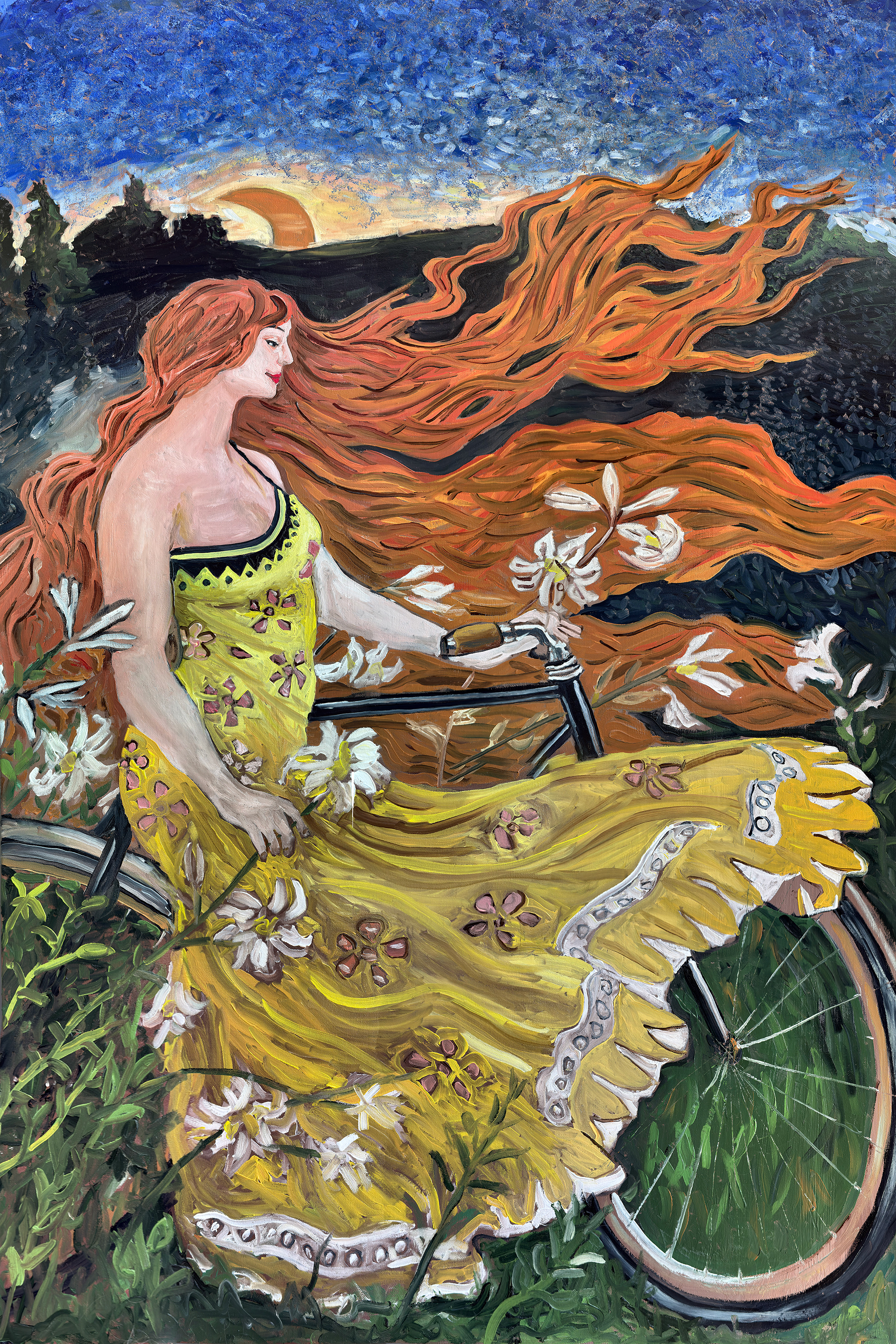
There is a specific quality to the light at the moment the sun drops below the horizon and the first crescent of the moon becomes visible. It is not dusk and not night. The sky is two things at once. The colors deepened by the retreating warmth of the day and cooled by the advancing dark - both present, neither dominant, holding the world in a brief equilibrium that lasts for minutes at most before it resolves into something simpler.
This is the moment The Crescent Moon lives in. Not before, and not after. Exactly here.
The Same Tradition, A Different Image
Luna and The Crescent Moon are in conversation with the same historical moment - the golden age of European cycling advertising, roughly 1890 to 1910, when the best poster artists of the era were commissioned to sell bicycles and made something that outlasted every product it was meant to promote. Both paintings work in that visual language. Both strip away the brand names, the dealer addresses, the price lists - the commercial apparatus that justified the image but constrained it. Both ask the question: what was the image always trying to be?
But they arrive at different answers. Luna reaches for the mythological - the winged figure atop the globe, the bicycle as a mechanism of transcendence. It is celestial in its ambition, placing the rider outside the world as a way of commenting on it.
The Crescent Moon stays earthbound. The rider is in the landscape, not above it. The crescent in the upper left is present but not dominant - a marker, not a destination. The painting's interest is not in reaching the sky but in what it feels like to move through the world at the precise hour when the sky changes, and to be on a bicycle when it does.
Hair as Landscape
The most immediately striking element of the painting is the figure's hair. Auburn, almost flame-colored, it streams behind her in a mass of movement that extends far beyond the edges of her body - crossing the bicycle, entering the treeline, occupying more of the canvas than any other single element. It is not decorative. It is structural. It is doing the compositional work of wind and motion and the visual logic of speed, all at once.
This is a very specific artistic tradition. Alphonse Mucha understood hair as a compositional tool - his poster figures are surrounded by it, framed by it, their hair becoming the elaborate organic border that organizes the space around them. The Pre-Raphaelites before him were obsessed with it: Rossetti's women are defined as much by the physical weight and mass of their hair as by their expressions. John William Waterhouse returned to it painting after painting - the hair catching light, trailing in water, extending into the world around the figure as if it were a living extension of her inner state.
In this painting, the hair is the motion made visible. The bicycle moves. The dress catches the air. But it is the hair that shows you how fast, in which direction, with what kind of energy. It also does something that none of the other compositional elements can do: it connects the figure directly to the landscape behind her, blending at its edges into the dark trees and the warm sky in a way that makes the boundary between person and place genuinely ambiguous. She is not riding through the landscape. She is, at least partially, the landscape. The line between rider and world has dissolved.
The great Art Nouveau artists understood this as a philosophical as much as a visual proposition: that a person moving through the natural world is not separate from it, but continuous with it. The bicycle, for them, was the machine that made this continuity possible.
The White Lilies
White lilies appear throughout European Art Nouveau - in Mucha's decorative borders, in the textile designs of William Morris, in the stained glass of the period, in the poster work of Privat-Livemont and Grasset. They are not an accidental choice. The lily carries a specific weight in the visual vocabulary of the era: purity, beauty, the natural world in its most formal expression, a flower that belongs simultaneously to the garden and to allegory.
In this painting they appear at the edges of the composition and scattered across the dress itself, their white flowers standing out against the yellow fabric and the dark greens of the surrounding field. They are not arranged or composed in any artificial sense. They are simply present - growing at the roadside, caught in the dress's hem, part of the landscape she is moving through. Their white against the warm tones of her dress and hair and the cooling blue of the sky creates a visual note that recurs across the canvas, linking the figure to the ground around her.
There is also something seasonal about them. Lilies at dusk, at this particular color of sky - this is late summer or early autumn, the tail end of warmth, the moment just before the year begins to turn. The crescent moon at harvest time. The last of the long evenings.
The Dress and the Color Logic
The yellow dress is unusual in the series. Most of the figures in these paintings wear white - the white of summer, of simplicity, of a form that reflects light rather than absorbing it. The choice of deep, saturated yellow here is deliberate and does specific work: it holds warmth against the cooling sky, creates a visual echo of the setting sun visible in the upper left, and establishes the figure as the warmest object in the composition at exactly the moment when warmth is leaving everything else.
The floral embroidery on the dress connects it to the lily tradition of the period - patterns of this kind appear in Art Nouveau textile and poster design throughout the 1890s and 1900s. The white lace trim at the hem and the dark edge at the neckline give it a specific period character: this is clothing from a moment when women's cycling dress was still navigating between fashion and function, still making arguments about whether a woman riding a bicycle could also be a woman dressed beautifully.
She can, and is.
No Urgency, Only Continuation
The bicycle is steady beneath her, and this matters. In a painting full of movement - the hair, the dress, the lilies in the air, the sky in transition - the bicycle is the still point. It is doing what bicycles do: providing a platform of reliable forward motion that frees everything else to move more freely around it. She is not working. She is not racing. She is simply continuing, at the pace the evening calls for, through a landscape that is changing around her.
This is what the Art Nouveau cycling posters were always pointing toward, underneath the brand names and the commercial copy. Not the bicycle as a product to be purchased, but the bicycle as a way of moving through the world - at human pace, fully present to the light and the air and the particular quality of this specific evening. The crescent rising. The sun already gone. The world in between, and a rider moving through it without hurry.
About the Painting
This work is an original oil on canvas, 40 inches wide by 60 inches tall, completed in January 2026. It is part of The Golden Age Series by Christopher Watson - an ongoing body of 50 original oil paintings exploring cycling, motion, and human perseverance. The Crescent Moon is one of two paintings in the series working directly in the tradition of Art Nouveau cycling advertising - the other being Luna - and the two are meant to be understood as a related pair. Where Luna reaches toward the mythological, The Crescent Moon stays in the world, placing the same visual language in service of a quieter, more earthbound moment.
Christopher Watson is a self-taught oil painter based in Peterborough, New Hampshire - a software engineer and endurance athlete with twelve Ironman finishes who began painting seriously in 2024. Cycling is his sole subject. The work is made by hand, one canvas at a time.
The original is available for private inquiry. Fine art archival prints are available in multiple sizes through the Velo Paintings print shop. If the image stays with you - the figure, the hair, the threshold between the warmth of day and the quiet of what comes after - that is what the print is for.