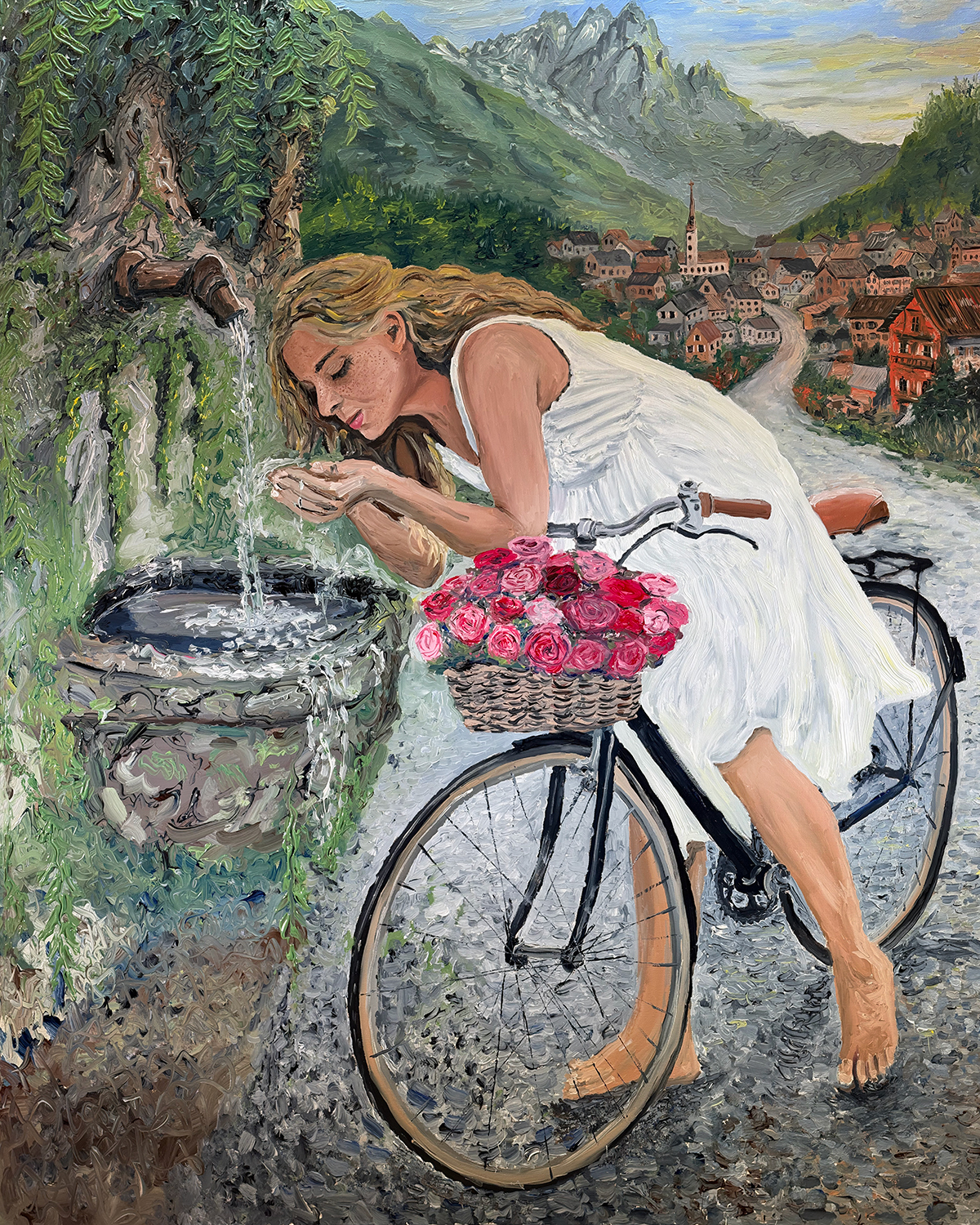
Some paintings begin with a research question or a historical moment. This one began on a road in the Alps in 2025, on a climb with no flat sections and cold water running from a stone spout at the side of the road.
The thought that arrived was immediate and specific: that's a painting.
The Fountains of the Alpine Roads
Anyone who has ridden through the Italian or Swiss Alps knows them. Stone basins set into walls, fed by mountain springs, water flowing continuously through carved wooden or iron spouts. Some are plainly utilitarian. Some are elaborately decorated, the stone worn smooth by centuries of use. All of them are cold in a way that nothing else is cold - genuinely alpine water, pulled from snowmelt and deep rock, arriving at your hands at a temperature that makes the heat of the road feel like a different world.
These fountains have been there for centuries. Long before the roads were paved, long before the first cyclists arrived with their steel machines and their wool jerseys, the springs were flowing. They served farmers moving livestock between summer and winter pasture. They served traders crossing the passes. They served soldiers and pilgrims and anyone else for whom the Alps were something to be crossed rather than admired from a distance. When the cyclists arrived - first in the late 1890s, then in earnest when the great races began threading through these mountains in the 1900s and 1910s - the fountains were already ancient.
For the early riders of the Giro d'Italia and the Tour de France, these roadside springs were not a convenience. They were survival. Before domestiques and team cars and feed zones organized down to the minute, a rider who needed water on a mountain climb found it where everyone else had always found it: at the wall, from the spout, with their hands or their bottle, for as long as it took to drink enough and continue.
The fountain in this painting is that fountain. Not a specific one, but the idea of all of them - a presence in the landscape so old and so constant that it barely registers as remarkable anymore, except to someone who arrives there at exactly the right moment on exactly the right kind of afternoon.
The Moment
The image at the center of The Stone Fountain is a very specific observation about what happens when something becomes habitual.
A rider who has ridden through the Alps enough times knows the fountains. Knows where they are. Has stopped at them before, will stop at them again. And at some point, the stopping becomes so practiced, so familiar, that it stops being a full stop. You don't dismount. You don't set foot on both sides of the bike and lean it against the wall like a tourist would. You coast up, put one foot down, lean over the handlebars, and drink from your cupped hands while the bike is still between your legs.
It is an entirely unremarkable movement for someone who has done it a hundred times. It is a movement that is almost impossible to describe to someone who hasn't - the specific balance required, the way the bars give slightly against your weight, the slight tilt of the frame, the coolness of the water arriving at your face while the warmth of the ride is still in your legs.
That balance - effort and ease held in the same gesture - is the painting's central idea. She is tired, a little lazy, barefoot on a hot afternoon. She is not in a hurry. She is not racing anywhere. But she is still on the bike, because getting off would require more energy than simply leaning over and drinking. Experience has made the effortful thing easy. The road has made her fluent in exactly this kind of movement.
The Village Behind Her
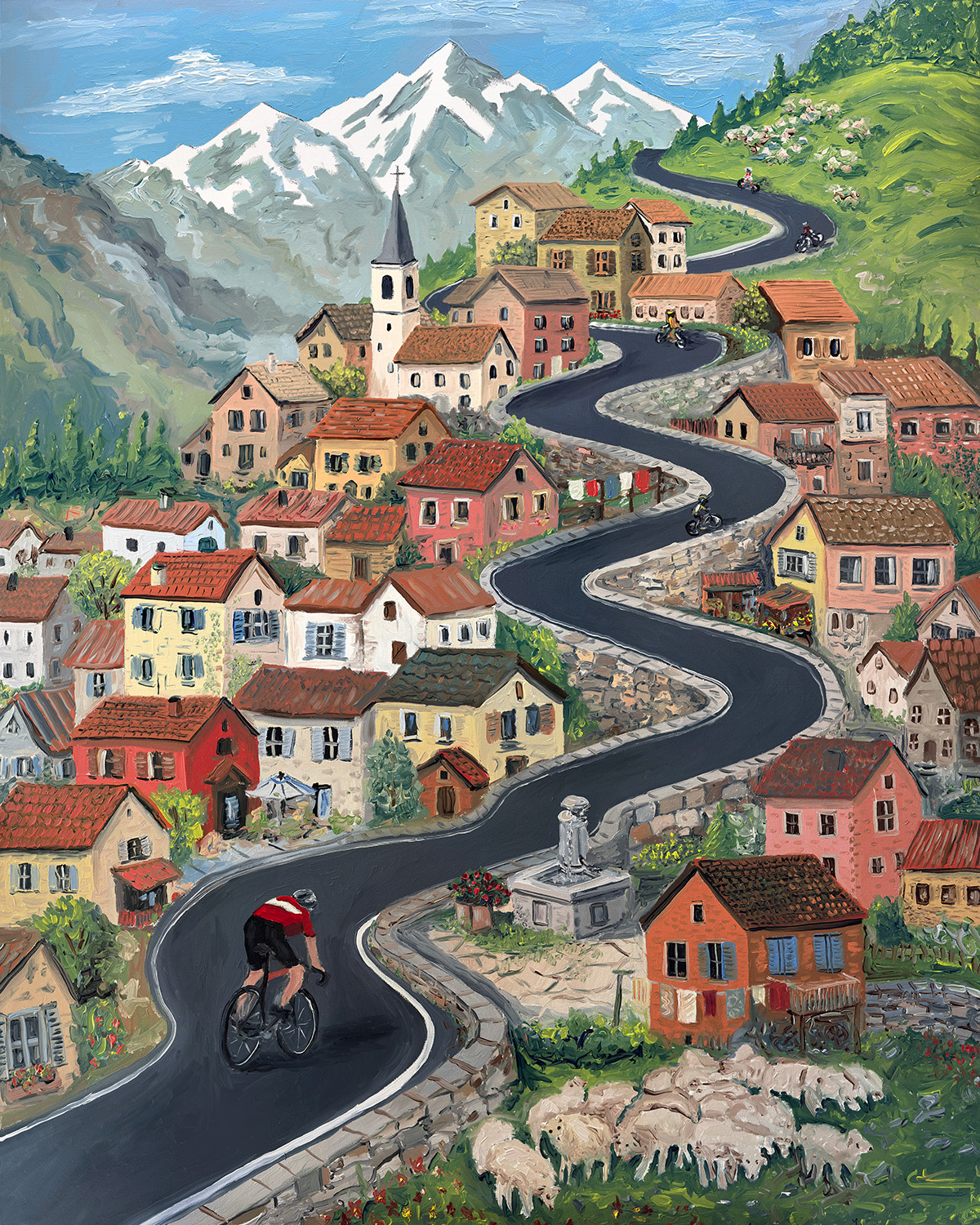
The village in the middle distance is doing important work in the composition. It establishes that this is not wilderness. This is a lived landscape - centuries of human habitation, a church spire, clustered rooftines, roads that connect to other roads. The mountains behind it are vast, but they are not empty. People have been here for a long time.
The road she came down curves through the village and continues upward into the frame. It is a road with a history. It was there before the bicycle, and the bicycle found it and made it new. Every alpine road that cyclists ride today was walked, and ridden on horseback, and driven by cart, by generations of people for whom the Alps were simply where they lived. The cyclist arrives into that history and becomes briefly part of it, and then continues on.
The stone fountain is the most direct expression of that continuity. It doesn't know what era it's in. It flows for whoever arrives.
Scale, Texture, and the Work of the Surface
This is a large painting - 48 inches wide by 60 inches tall, built to carry presence. At this scale, the figure approaches life-size, and the choice of scale is compositional rather than incidental. A smaller canvas would make this an illustration of a moment. At this size, the viewer enters the scene. You are standing at the fountain beside her.
The surface is one of the most texturally dense in the series. The stone basin alone required multiple passes - layered cool grays and mossy greens and earthy browns, built up to suggest the weight and age and moisture of the material. Stone that has had water running over it for a hundred years looks different from stone that hasn't, and that difference lives in the paint as much as in the subject. The water itself is handled differently: lighter, more fluid strokes, soft whites and translucent grays that capture movement without over-defining it. Water doesn't hold still long enough to be painted precisely. It has to be suggested.
The basket of roses on the front of the bicycle is the painting's moment of saturated color - crimson, pink, coral, built up in dense short strokes that give the petals texture and weight. Against the cooler tones of the stone, the road, and the distant mountains, they function as both a visual anchor and an emotional one. They are the evidence of an errand, a destination, a life that extends beyond this particular moment at this particular fountain.
The white dress, the bare feet, the warm skin tones - these required the most passes. Skin in alpine light, with cold water arriving at the hands, catches and reflects in ways that are difficult to resolve quickly. The goal was always to paint it warm without losing the sense of the mountain air around her. That tension between warmth and coolness runs through the entire canvas.
What the Ride Feels Like
The Golden Age Series is, at its core, a project about what riding a bicycle actually feels like - not as spectacle or performance, but as experience. The heroic paintings in the series - the mountain passes, the great races, the riders pushing through weather and exhaustion - are about cycling at its most dramatic. But some of the most true paintings in the series are about the quieter registers of the same experience.
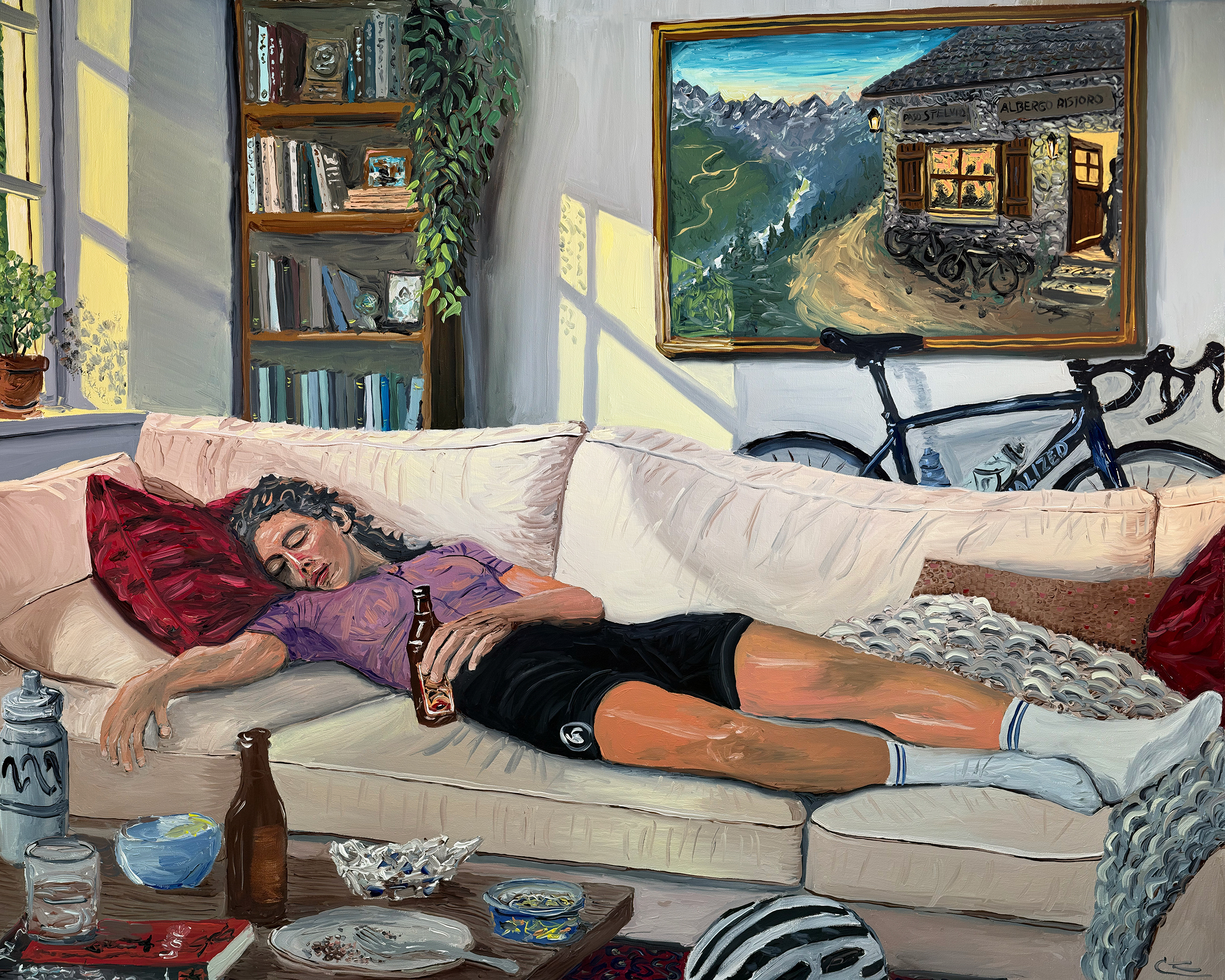
Couch Theory is about the earned rest after a long ride. The Telescope is about stillness after motion. The Stone Fountain is about the moment of fluid competence - the gesture so practiced it no longer requires thought, the road so familiar that the body handles it while the mind goes somewhere else. These are things that every serious rider knows and that almost no one paints, because they don't look like much from the outside. From the inside, they are the entire point.
The Alps in 2025. A climb without flat sections. Cold water from a stone spout. The thought that arrived: that's a painting.
It is.
About the Painting
This work is an original oil on canvas, 48 inches wide by 60 inches tall, completed in 2026. It is part of The Golden Age Series by Christopher Watson - an ongoing body of 50 original oil paintings exploring cycling, motion, and human perseverance. The Stone Fountain was inspired directly by the roadside springs found throughout the Italian and Swiss Alps - stone basins fed by mountain springs that have served travelers, farmers, and cyclists for centuries. The painting is one of the most texturally complex works in the series, built in multiple passes across stone, water, skin, cloth, and the Alpine landscape behind the figure.
Christopher Watson is a self-taught oil painter based in Peterborough, New Hampshire - a software engineer and endurance athlete with twelve Ironman finishes who began painting seriously in 2024. Cycling is his sole subject. The work is made by hand, one canvas at a time, and the series draws directly on decades of riding experience.
The original is available for private inquiry. Fine art archival prints are available in multiple sizes through the Velo Paintings print shop. At nearly life-size scale, the large-format print carries the presence the painting was built for.