Most paintings in The Golden Age Series are about movement. About the body under pressure. About weather and endurance and what a person finds out about themselves when the road won't end. The Telescope is about what happens when all of that finally stops.
This painting is an act of stillness - and it is, in its own way, the most ambitious work in the series.
Cecilia Payne and the Sky That Changed Everything
In the early decades of the twentieth century, when the night sky still belonged to those willing to seek it, a young woman moved quietly through Cambridge, Massachusetts.
Her name was Cecilia Payne.
She had come from England with a mind sharpened by physics and a curiosity that refused to settle. At the Harvard College Observatory, she was permitted to work, to study, to observe. But like many women of her time, she existed just outside the center of recognition - close enough to see everything, far enough to be overlooked.
The prevailing belief of the time held that the stars were composed much like the Earth: heavy elements, familiar materials, a universe that mirrored the known world. Payne looked at the same evidence and saw something else entirely. Hydrogen. Helium. The lightest elements, in overwhelming abundance.
It was a conclusion as radical as it was simple. The universe was not built from the same substance as the Earth. It was something far more elemental, far more vast. When she submitted her doctoral thesis in 1925, the committee was so unsettled by her findings that she was pressured to walk back her own conclusions. She did so, reluctantly, in the published version. Within a few years, the scientific consensus had quietly caught up with what she had already known.
Cecilia Payne-Gaposchkin - as she later became known - is now considered to have made one of the most significant discoveries in the history of astronomy. She was twenty-five years old when she made it.
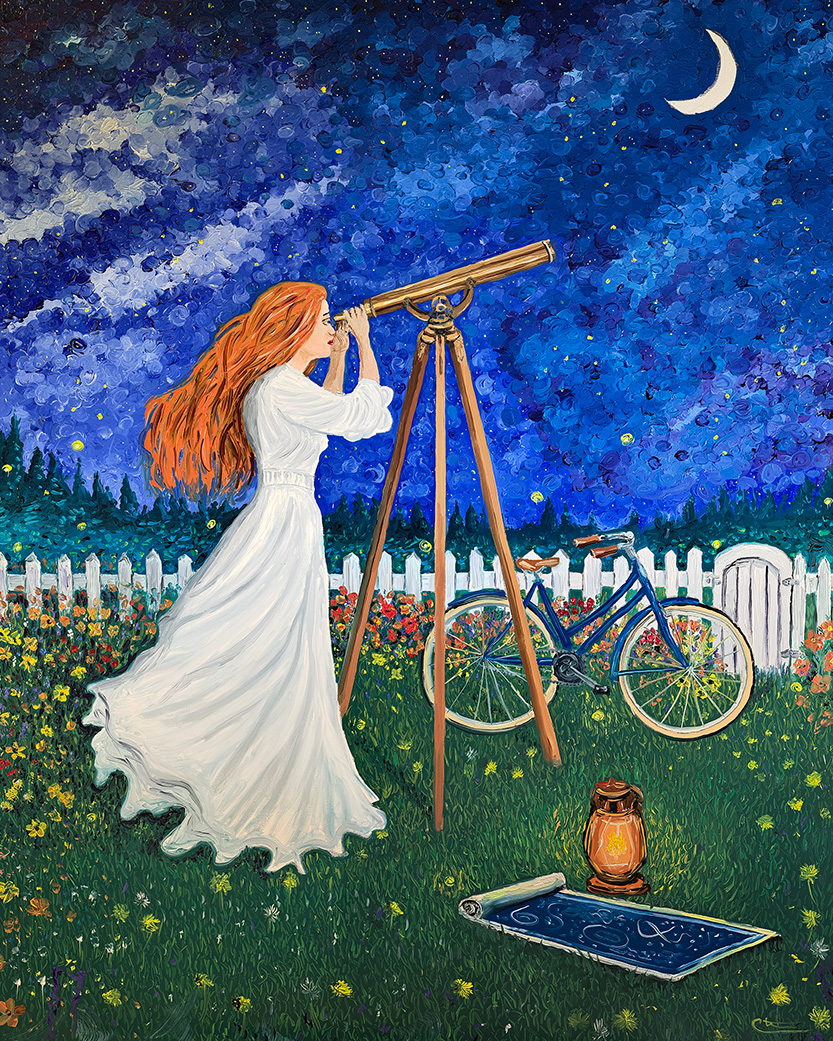
The painting does not depict a documented scene. There are no official records of those nights, no photographs, no entries in the formal logs. But the image it holds is historically grounded in its spirit: a woman alone in a field, with a bicycle, a lantern, and a telescope, looking at a sky that most people around her had stopped looking at. Doing her work in the hours when the institutions that constrained her were finally quiet.
The Sky Is Real
One of the defining decisions made during the creation of The Telescope was that the night sky would not be invented. The constellations in the painting are astronomically accurate - reconstructed from real celestial positioning from the 1920s, locked to a specific date, time, viewing direction, and location.
This transformed the painting from a fictional night scene into something else: a preserved moment that could have truly existed. The sky above the woman is the actual sky. The stars she is looking at are where they were. If you knew the date and you knew where to stand, you would have seen the same sky she is seeing.
That decision is the painting's most quietly radical element. It took what might have been an atmospheric composition and made it a document. A historical object. The kind of thing that, a hundred years from now, could be used to identify the night.
The Telescope Itself
The brass telescope at the center of the composition was modeled after an authentic instrument from the era - specifically inspired by a Bausch and Lomb Harbormaster telescope, a design whose polished surfaces and wooden tripod were among the most recognizable scientific instruments of the early twentieth century.
The choice was deliberate. A telescope of this kind was not a casual object. It required patience to operate, knowledge to use, and physical engagement with the observation process. You had to align it, focus it, move with it as the earth turned. You were not a passive recipient of information. You were a participant in the act of discovery.
In the painting, the brass surfaces catch the lantern light and carry it upward into the composition, creating a visual link between the warm world of earth and the cool world of the sky. It is both a scientific instrument and a piece of craftsmanship - a made object that reflects the same values the era attached to the bicycle: precision, independence, and the rewards of sustained attention.
The Bicycle in the Background
The navy bicycle leaning against the white picket fence is easy to miss at first. It is not the subject of the painting. It doesn't need to be.
Its presence establishes everything about how she arrived here, and what kind of person she is. She did not ride to this field by accident. She came deliberately, with equipment, in the dark, on her own. The bicycle is the instrument of her independence as surely as the telescope is the instrument of her inquiry.
This is the connection to the broader series. The Golden Age of Cycling was also, in a very real sense, the golden age of this kind of independence - the age when roads stretched into the countryside long before automobiles dominated them, when people traveled slowly enough to experience the landscape intimately, and when a bicycle represented genuine freedom of movement for anyone willing to use it. The women who rode in that era were making a statement with every mile. The woman in this painting is making a different kind of statement, with a different instrument, but the underlying fact is the same: she is here because she chose to be, on her own, and she got here herself.
Light, Color, and the Feeling of the Painting
Much of the emotional weight of The Telescope comes from the interaction between two light sources - the cool blue of the night sky and the warm amber of the hurricane lantern in the foreground. They do not compete. They negotiate. The lantern's warmth spreads softly through the grass and flowers, while the sky's blue deepens behind the trees and across the upper field of the canvas. The woman in white stands at the boundary between both.
The wildflowers are doing similar work. The dense scatter of oranges, reds, and yellows in the flower beds create a warmth at ground level that mirrors the lantern light and pulls the eye across the foreground before releasing it upward toward the sky. The fireflies - small points of gold that drift through the middle distance - act as visual bridges between the stars above and the illuminated flowers below, connecting two registers of the same image and helping unify the composition across its full height.
The star chart rolled in the grass beside the lantern completes the picture of someone who came here prepared. This is not a casual glance at the sky. It is an act of serious attention.
Ten Days and the Analog World
The painting developed over ten consecutive days. Early sessions established composition and atmosphere. Later stages introduced increasingly fine detail: the texture of the grass, the individual wildflowers, the glow of the fireflies, the subtleties within the sky. Elements emerged that weren't planned - the relationship between the fireflies and the stars being the most significant, a discovery that came from looking at the painting in progress and recognizing a visual logic that hadn't been anticipated at the start.
That process mirrors something the painting is itself about. The Telescope is, among other things, a reflection on what it meant to live in the analog world - the final decades before technology permanently transformed the human relationship with silence, time, and attention. Before glowing screens replaced darkness. Before the night sky became a background rather than a destination.
In the 1920s, a person riding out to a field at night to look at the stars was not doing something unusual. The stars were still there, available, part of everyday experience for anyone who looked up. What Cecilia Payne was doing was unusual - but the act of looking was not. That ordinariness is part of what the painting is mourning, quietly, and preserving.
A Note on the Archival Capture
Upon completion, the original oil painting underwent an ultra-high-resolution imaging process exceeding 900 megapixels. This archival capture preserves every brushstroke, every texture transition, every subtlety within the surface of the oil paint - allowing museum-quality reproductions to retain much of the physical presence of the original canvas. At this resolution, the individual brushwork that builds the night sky and the texture of the brass telescope are fully recoverable in large-format print.
About the Painting
This work is an original oil on canvas, 48 inches wide by 60 inches tall, completed on April 25, 2026. It is part of The Golden Age Series by Christopher Watson - an ongoing body of 50 original oil paintings exploring cycling, motion, and human perseverance. The Telescope occupies a distinct position within the series: where most works are about movement and effort, this one is about stillness, observation, and the quieter forms of ambition. It is the series' most direct engagement with women in science, and its most astronomically precise work - the night sky is historically accurate to real celestial positioning from the 1920s.
Christopher Watson is a self-taught oil painter based in Peterborough, New Hampshire - a software engineer and endurance athlete with twelve Ironman finishes who began painting seriously in 2024. Cycling is his sole subject. The work is made by hand, one canvas at a time.
The original is available for private inquiry. Fine art archival prints are available in multiple sizes through the Velo Paintings print shop. At the scale this painting was made - and given the resolution at which it was captured - large-format prints carry a presence that smaller reproductions cannot. If the painting stays with you, the print belongs on your wall.