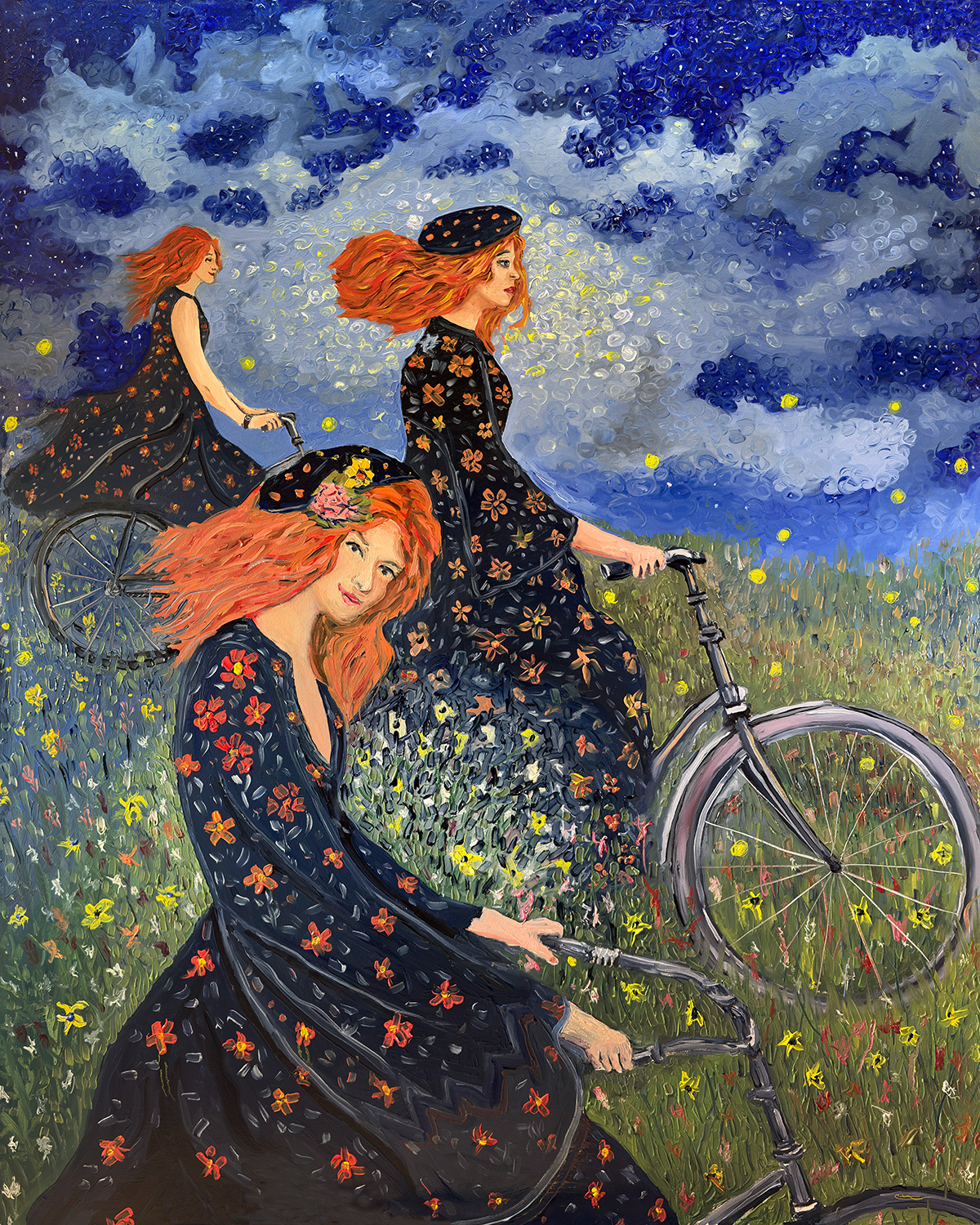
Three women. Three bicycles. A field of wildflowers under a churning night sky. The same red hair catching the same wind, the same black dress with its scattered flowers, the same expression - somewhere between contentment and momentum.
The painting is called The Three Sisters, and it sits at the intersection of two things that defined the turn of the twentieth century: the bicycle, and the liberation of women. This is the story behind the image.
The Bicycle and the New Woman
In 1895, Susan B. Anthony gave an interview to journalist Nellie Bly. She was asked what she thought of the bicycle craze then sweeping America and Europe. Her answer has been quoted ever since: "I think it has done more to emancipate women than anything else in the world. I stand and rejoice every time I see a woman ride by on a wheel. It gives women a feeling of freedom and self-reliance."
She was not speaking metaphorically. The bicycle, in the final decade of the nineteenth century and the first decade of the twentieth, was genuinely transformative for women in ways that are difficult to fully appreciate from the vantage of the present. To understand why, you have to understand what women's lives looked like before it.
A woman in 1890 moved at the speed of her chaperone, her husband, or the horse and carriage her family could afford. Public transport existed in cities, but the radius of an independent woman's movement was sharply constrained by social convention as much as by physical infrastructure. She could not simply go somewhere. She required permission, escort, or both.
The bicycle changed that. For the first time, a woman could leave her home alone, under her own power, and go somewhere - anywhere within reach of her legs and her endurance. She did not need a horse. She did not need a driver. She did not need to explain herself. She simply rode.
The Marketing Campaigns
The bicycle manufacturers of the 1890s understood this immediately. What they had on their hands was not merely a piece of transport technology but a social proposition, and they marketed it accordingly.
Pope Manufacturing, makers of the Columbia bicycle, produced advertising materials in the 1890s that placed women at the centre of the cycling life. Their posters showed women riding confidently through parks and along country roads, often alone, often at speed, often smiling. The message was consistent: this machine is for you. You belong on it. You are free on it.
The Stearns Bicycle Company went further. Their famous poster campaigns of the late 1890s, rendered in the Art Nouveau style then fashionable, showed women cyclists in flowing dress against ornate backgrounds of flowers and vines - the visual language of femininity deliberately fused with the image of a vehicle. The bicycle was not something imposed on women from outside their world. It was part of their world. It grew from it.
Victor Bicycles ran campaigns using the phrase "Ride a Victor" alongside images of independent women navigating city streets and country lanes. The Overman Wheel Company, which manufactured Victor, was among the first American manufacturers to explicitly target women as a primary market rather than an afterthought.
In Europe, the tradition was even more pronounced. French and Belgian manufacturers commissioned posters from artists working in the full Art Nouveau mode - Alphonse Mucha's influence was everywhere. Women in these posters were not merely riding bicycles; they were part of a visual universe in which the bicycle was an extension of the natural world, of flowers and motion and wind, rather than a piece of industrial machinery.
Edward Penfield, the American illustrator who served as art director for Harper's magazine through much of this period, created cycling posters that treated women on bicycles with the same casual confidence he brought to men. His women cyclists were not performing liberation. They were simply going somewhere. The normalcy of it was the point.
Dress Reform and the Practical Revolution
The bicycle also forced a practical confrontation with women's clothing that had significant cultural consequences. Riding a bicycle in the full Victorian dress of the early 1890s was genuinely dangerous. Long skirts caught in wheels and chain rings. Tight corsets restricted breathing under exertion. Heavy petticoats shifted unpredictably and affected balance.
Women cyclists began wearing rational dress - bloomers, divided skirts, shorter hemlines - and the social controversy this generated was entirely disproportionate to the matter at hand. Newspapers published editorials. Clergymen gave sermons. The question of whether a woman was permitted to dress practically for a practical activity became a proxy for a much larger argument about what women were permitted to do at all.
Tessie Reynolds, a British cyclist, rode 120 miles from Brighton to London and back in 1893 wearing rational dress and completed the journey in under nine hours. The press coverage was enormous. She was nineteen years old. The story was not really about her ride - it was about her trousers.
Annie Londonderry, whose given name was Annie Cohen Kopchovsky, left Boston in 1894 and cycled around the world, completing the journey in fifteen months. She wore men's cycling attire for much of the trip, accepted sponsorship from a French mineral water company (whose name she rode under), and returned to considerable fame and controversy. She was twenty-three when she left. The journey was partly a bet - two wealthy Boston men had wagered that a woman could not do it.
She did it.
The Visual Language of Women Cycling
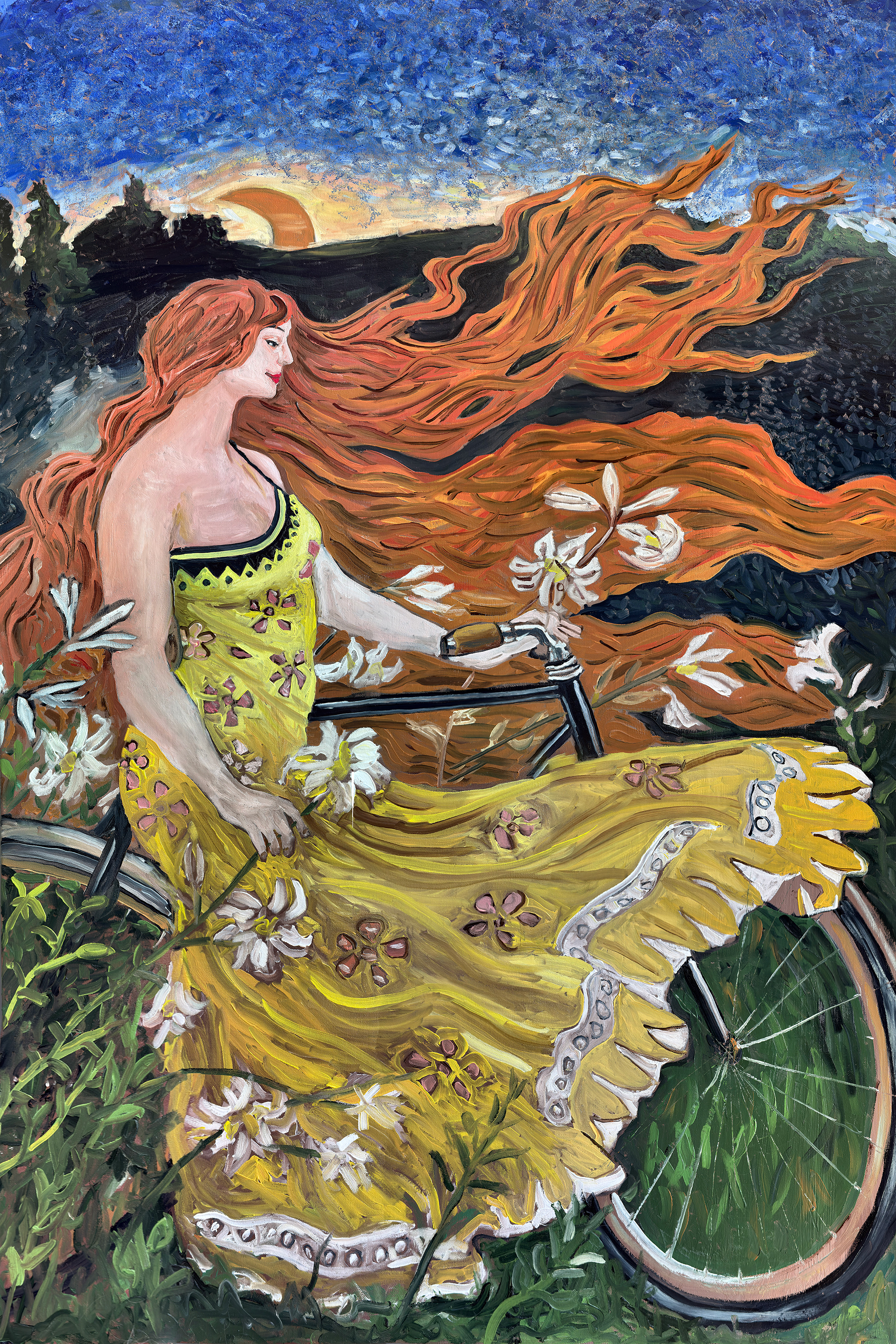
What the great poster artists of the 1890s and 1900s understood was that the image of a woman on a bicycle carried emotional weight that exceeded its literal content. It was an image of pleasure, of competence, of independence, of physical capability. It showed a woman moving through space under her own power, in control of her own direction, going somewhere of her own choosing.
The visual conventions they developed have proved remarkably durable. The combination of flower imagery and bicycle, of wind-blown hair and spinning wheels, of the night sky and the open field - these associations have persisted across more than a century because they speak to something real. The bicycle, for women, was always about more than getting from one place to another. It was about the right to move at all.
The three women in this painting occupy a tradition that runs directly from those Art Nouveau posters of a hundred and thirty years ago. The swirling sky, the wildflowers at their wheels, the hair loose and caught by speed - these are not incidental details. They are the language the painting speaks.
The Painting
The three figures in The Three Sisters are the same woman seen at different distances, different moments in time, or different aspects of the same experience. The composition moves from foreground to background along a diagonal of movement and receding scale, each figure progressively smaller, progressively further from the viewer, progressively more absorbed into the sky and the field.
The night sky carries the influence of Van Gogh's Starry Night - the swirling, textured blue, the yellow points of light scattered through it. But where Van Gogh's sky dominates and overwhelms, here the sky is background rather than subject. The women are the subject. The sky is the world they move through.
The palette is dark and rich: navy and midnight blue in the dresses, the deep green of the field, the vivid orange-red of the hair that is this painting's most persistent visual element. Against the darkness, the wildflowers scatter their yellows and reds like sparks. The bicycles are rendered in grey - present, functional, the enabling fact of everything else in the frame.
Oil on canvas allows a surface quality that is part of the meaning here. The brushwork is loose and accumulative - the flowers in the field and the dress built up in short, dense strokes that give them texture and movement. The figures themselves are more resolved, more particular. The woman closest to the viewer meets the eye with a specific, private expression. She is not performing joy. She is simply present in a moment of motion, and she is content.
What the Bicycle Was, and Is
The cycling campaigns of the 1890s and 1900s were selling a machine, but what they were selling alongside it was a vision of women's lives that was, for its time, genuinely radical. A woman alone on a bicycle, going somewhere, was a statement. The manufacturers understood this and used it. The women who rode understood this and lived it.
The bicycle is still that. It is still a machine that gives its rider autonomy, mobility, the capacity to move through the world under their own power and on their own terms. The wildflowers are still there. The wind is still in the hair. The road still goes somewhere.
About the Painting
This work is an original oil on canvas, 48 inches wide by 60 inches tall, completed on March 28, 2026. It is part of The Golden Age Series - an ongoing body of work by Christopher Watson exploring cycling, motion, and human perseverance. The series ranges across cycling history and culture: the great races, the mountain passes, the forgotten riders, and the broader human stories that the bicycle makes possible. The Three Sisters sits in the series as a piece about what cycling has always meant to women - independence, mobility, and the freedom to go somewhere on your own terms.
Christopher Watson is a self-taught oil painter based in Peterborough, New Hampshire. He is also a software engineer and endurance athlete - twelve Ironman finishes, thirty years of racing. He paints in oil on canvas, working from reference and from memory, exclusively on cycling subjects. The Golden Age Series is his primary body of work, and it is ongoing.
The original painting is available for private inquiry. Fine art archival prints are available in multiple sizes through the Velo Paintings print shop - museum-quality archival paper and canvas, individually fulfilled. If the image and the history behind it stay with you, that is what the prints are for.