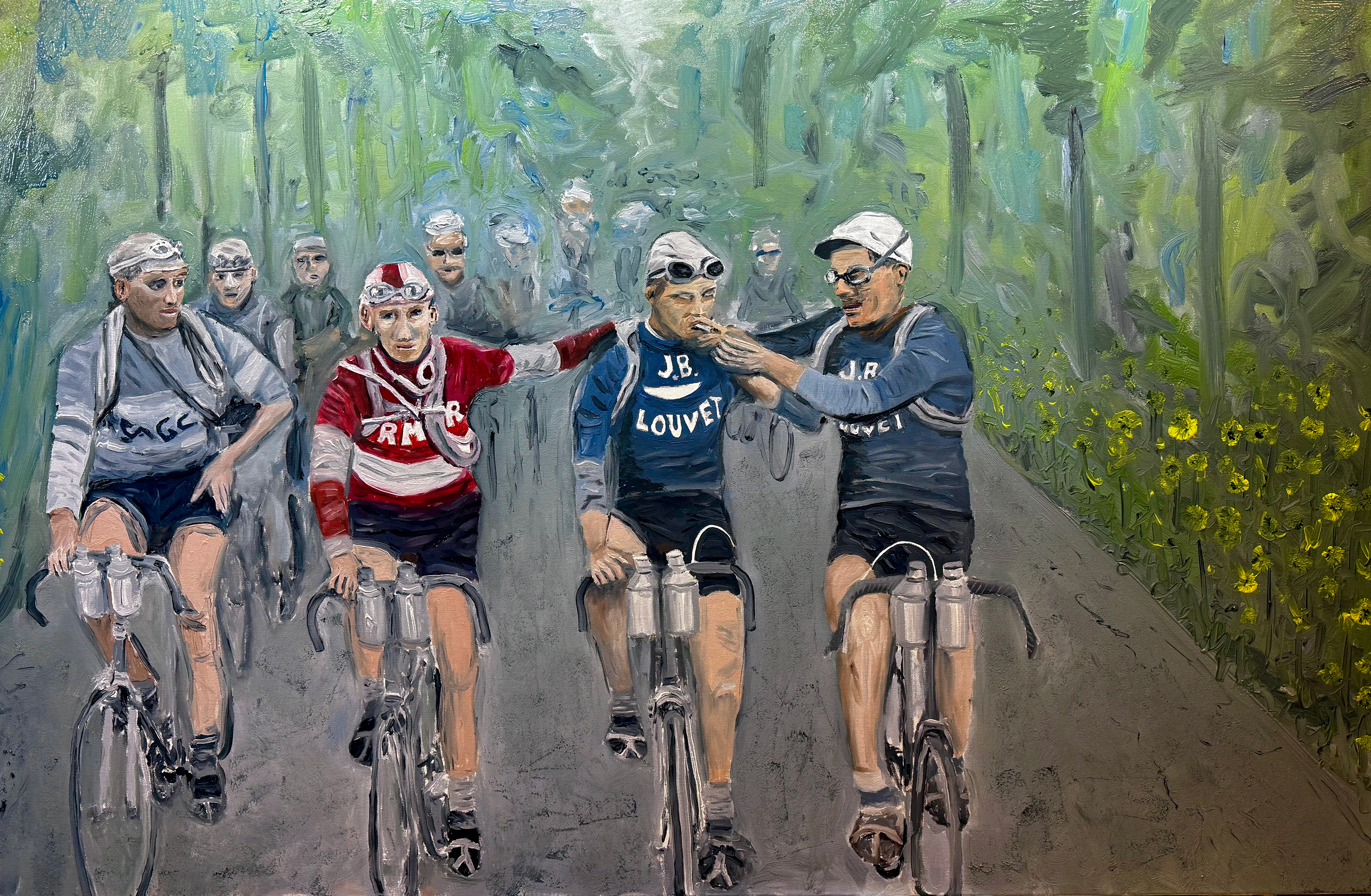
In the summer of 1927, 133 riders left Paris and headed into the unknown. The roads were mostly unpaved. The Alps and Pyrenees waited like a sentence, not a challenge. And somewhere in that peloton was a quiet, methodical rider from Luxembourg named Nicolas Frantz, who would not just win the Tour de France - he would dominate it in a way that hadn’t been seen before and wouldn’t be seen again for decades.
This is the story behind the painting.
The World of the 1927 Tour
To understand what the 1927 Tour de France meant, you have to understand what cycling was in that era. It wasn’t a sport in the modern sense. It was something closer to a test of character - a public event staged by newspapers to sell papers, entered by men who were as much adventurers as athletes.
The Tour had been running since 1903. By 1927 it had survived the First World War (it was cancelled from 1915 to 1918), a German occupation, and the near-bankruptcy of its founding publication, L’Auto. It had also evolved from its original stage format into something approaching the race we recognise today: a multi-week ordeal across the full geography of France, with mountain stages that would break the body and unmade roads that would test everything else.
The 1927 edition covered 5,340 kilometres over 24 stages. Average stage length: 222 kilometres. The longest single stage - from Les Sables-d’Olonne to Bordeaux - was 412 kilometres. Riders raced on it for 17 hours.
The Bikes
The machines they rode were hand-built steel bicycles, single-speed or with a two-speed flip-flop hub - one gear ratio on each side of the rear wheel. To change gear in the mountains, you stopped, loosened the rear axle nuts, flipped the wheel, re-tensioned the chain, and continued. The whole process took less than a minute if you were practiced. It still took a minute.
Frames were heavy by modern standards: typically around 12 to 14 kilograms for a complete machine. Tubing was thick-gauge steel, lugged and brazed by craftsmen who had been making frames since the 1890s. The geometry was upright and stable, designed for endurance over hours rather than efficiency over watts. Brakes were rudimentary - rod or cable-actuated rim brakes that were largely ineffective on wet descents, which is why riders regularly descended the Alps with their feet dragging on the road surface as a supplement.
Handlebars were drop bars, but the drops were shallow. Saddles were leather, broken in over months before a major event - a new saddle on a Grand Tour stage was a form of suffering in itself. Pedals were simple quill-style toe clips with leather straps. Riders wore wool jerseys, wool shorts, and leather shoes with smooth soles. Cotton caps, pulled down against the sun.
There was no aero equipment. No carbon. No power meters. The closest thing to sports nutrition was a musette bag filled with whatever the rider or his soigneur had prepared: bread, ham, cheese, rice cakes, and in some cases wine. Anecdotal accounts from this period suggest that wine in small quantities was considered both caloric and nervine - settling to the stomach on a long flat stage.
Nicolas Frantz and the Dominant Ride
Nicolas Frantz was 29 years old in 1927. He had been racing professionally since the early 1920s and was already a known quantity in the European peloton - a classic rider who had won Paris–Roubaix in 1921 and finished second overall at the 1926 Tour. He rode for the Alcyon-Dunlop team, one of the leading trade squads of the era, backed by a bicycle manufacturer whose name appeared across the peloton on frames, jerseys, and caps.
The 1927 Tour was a team event in a way modern fans wouldn’t quite recognise. Riders competed for their trade teams, and overall classification was secondary for some. But Frantz came into the race as a genuine contender, and he rode like one from the opening stages.
He took the yellow jersey early and, crucially, kept it. Across the Pyrenees and then the Alps, through the flat northern stages and the brutal kilometres of the Massif Central, Frantz defended his position with a combination of consistent climbing, disciplined racing, and tactical intelligence. He didn’t need to attack every day. He needed to be there at the end of every day, and he was.
His winning margin: 1 hour, 48 minutes, and 21 seconds. In a race that lasted over 198 hours of total racing time, that is a substantial advantage - a reflection not just of physical dominance but of the accumulated effect of riding consistently better than everyone else across three weeks and five thousand kilometres.
He would return in 1928 and win again.
The Mountain Stages
The defining moments of the 1927 Tour were, as they always were, in the mountains. The Pyrenean stages crossed the Col d’Aubisque, the Col du Tourmalet, the Col d’Aspin, and the Col de Peyresourde - the same climbs that riders still race today, though the roads are now paved and the crowd barriers are made from advertising boards rather than ropes and village walls.
In 1927, the roads over these passes were rough-graded dirt and gravel. They were rutted by rain, dusty in the dry, and treacherous in both conditions. Riders climbed them seated for the most part, not because they preferred it but because the gearing left them no alternative - standing and dancing on the pedals requires the right gear ratio, and on a flip-flop hub there were only two options.
The Alpine stages came later in the race, when the riders were already depleted. The Galibier. The Col d’Izoard. The passes that climb above 2,000 metres into cold, thin air where the road switchbacks through scree and the only sound is wind and the occasional cowbell. Frantz was reliable through all of it - present, strong, measured.
The Culture of the Race
The 1927 Tour de France was a cultural event as much as a sporting one. L’Auto, the newspaper that organised it, published daily coverage that reached millions of readers. The Tour was how France understood itself: the regions, the roads, the climbs, the agriculture and industry of each zone passed through on the map. The race was a form of national inventory.
Spectators lined the roads in their hundreds of thousands, particularly on the mountain stages. They arrived the night before on foot, bicycle, and by train, camping on the cols. In the morning they waited, sometimes for hours, for the peloton to emerge from the valley. When the riders came, they came fast on the descent and slow on the climb - and the crowd was close enough to touch them. Close enough to push a favourite up the steepest ramps, which happened, and was quietly tolerated.
The riders were celebrities in a way that had no real precedent. The Tour de France had created a new kind of public figure - the champion cyclist - who was neither an aristocrat nor a soldier but a working man made extraordinary by physical capacity. Frantz, from the small country of Luxembourg, was known across France. His name appeared in headlines. His face was on posters. He wore the yellow jersey, which Henri Desgrange had introduced in 1919, and the yellow jersey meant something specific: you were the man in front.
What the Painting Captures
When I set out to paint this era, I wasn’t trying to document a specific moment from the 1927 race. I was trying to get at something less specific but more essential: what it felt like to be a rider in that world. The particular quality of light on a mountain road in July. The weight and texture of a wool jersey. The geometry of a steel frame against an empty sky.
Oil on canvas is, in some ways, the right medium for this subject. Cycling in the 1920s was tactile, material, physical in a way that modern sport often isn’t. Everything had weight. Everything had surface. The leather saddle, the steel frame, the road, the mountains - all of it had a quality that oil paint can approximate in a way that photography sometimes can’t, because photography freezes a moment while paint, at its best, accumulates meaning across the surface.
The colour palette is warm and slightly muted - the palette of period photographs and early Technicolour, the palette of memory rather than the present. The composition places the rider in the landscape rather than above it; he is part of the road and the mountain, not separate from them.
This is the world Nicolas Frantz moved through in the summer of 1927. These are the roads. This is the light.
The Legacy
Nicolas Frantz is not as well-known as Coppi or Merckx or Indurain. He belongs to an earlier era, when the Tour de France was still finding its shape and the culture of professional cycling hadn’t yet calcified into the structure we know. But his two consecutive wins - 1927 and 1928 - mark him as one of the dominant riders of his generation, and the 1927 race in particular stands as one of the great sustained performances in Tour de France history.
More than that, the era he raced in represents something worth preserving in the imagination: a moment when the sport was genuinely dangerous, genuinely unknown, genuinely heroic in the old sense of the word. The riders who lined up in Paris in July 1927 knew they were going to suffer. They went anyway. For five thousand kilometres across the roads of France, on steel bicycles with two gears and leather shoes, they went anyway.
About the Painting
This work is an original oil on canvas, 60 inches wide by 40 inches tall, completed on February 18, 2026. It is part of The Golden Age Series — an ongoing body of work by Christopher Watson exploring cycling, motion, and human perseverance through the lens of the sport's early history. The series draws on the period from roughly 1890 to 1960, when professional cycling was at its most elemental: before team radios, before carbon fibre, before the full apparatus of modern sport surrounded the rider. Just a person, a steel machine, and a road.
Christopher Watson is a self-taught oil painter based in Peterborough, New Hampshire. He is also a software engineer and endurance athlete — twelve Ironman finishes across thirty years of competition. He began painting seriously in 2024, and cycling is his exclusive subject. He paints from reference, from memory, and from a lifetime spent on a bicycle. The work is not illustration or graphic art. It is fine art oil painting, made by hand, one canvas at a time.
The original painting is available for private inquiry. Fine art archival prints are available in multiple sizes through the Velo Paintings print shop, printed on museum-quality rag paper and canvas and fulfilled individually. If this painting and the history behind it resonates with you, the print is a way to keep it.