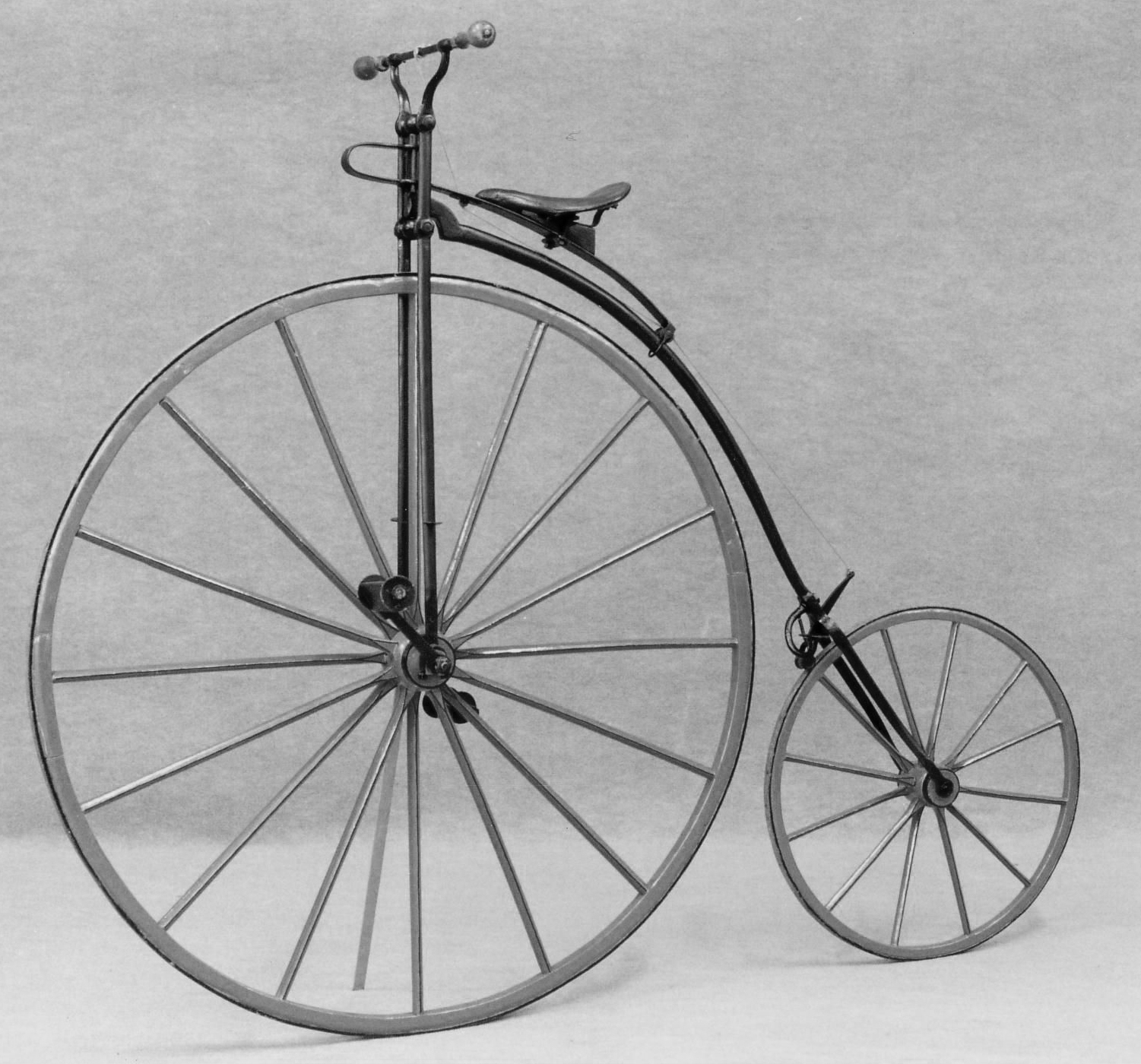
When Maurice Garin crossed the finish line in Paris on August 2, 1903, becoming the first winner of the Tour de France, his bicycle weighed eighteen kilograms. It had no gears. The brakes were barely functional. The roads were unpaved, rutted, and in places little better than farm tracks. And its wheels, the most visible and most debated component of every racing bicycle of that era were made of wood.
Most people, hearing this, picture something close to a cart wheel: solid timber, crude, the kind of thing you'd find on a medieval wagon. The reality was more sophisticated, and the story of how wood was slowly, reluctantly, and in one case secretly displaced from bicycle racing is one of the more interesting chapters in the history of cycling technology.
What a Wooden Wheel Actually Was
By 1903, the solid wooden wheel had long been obsolete. The wire-spoke tension wheel - invented by Frenchman Eugène Meyer in 1869 - had transformed bicycle design in the 1870s and 1880s, replacing heavy wooden discs and iron-shod rims with a structure of tensioned wire spokes radiating from a central hub. This was one of the genuine engineering leaps of the nineteenth century: a wheel that was lighter, stronger, and more responsive than anything that had come before.
What remained wooden in 1903 was the rim - the outer hoop to which the tire was attached. The spokes were steel wire. The hub was steel. But the rim itself, the curved band that defined the wheel's circumference and bore the direct stress of the road surface, was laminated wood. Typically ash - the same dense, flexible hardwood used for tool handles and carriage frames - bent and laminated into a hoop, finished smooth, and lacquered against moisture. On a well-made wooden rim, the grain ran along the curve of the bend rather than across it, which gave the material its resilience. Fine-grained hickory was also used, particularly in American production, where tests showed the lighter wood sustained ten to fifteen percent greater weight before breaking than its coarser-grained counterpart.
These rims were not light by modern standards - a wooden rim of the 1903 era typically weighed around 1,200 grams. But compared to the forged steel alternatives then available, they were competitive on weight, superior on vibration damping, and far cheaper to produce at scale. On roads of the quality the 1903 Tour traversed, the wood's natural flex absorbed enough road shock to matter. The tires - narrow tubulars, glued directly to the rim surface - sat well on the curved wooden bed. The system worked.
The Builders
The wooden rim was a cottage industry before it was a factory product. In France, the explosion of cycling in the 1890s - four million bicycles in use in the United States alone by 1895, with comparable growth in Europe - created enormous demand for quality rims, and workshops across Lyon and the surrounding region built their businesses on supplying it.
The most consequential of these was founded in 1889 by Charles Idoux and Lucien Chanel in Lyon: the company that would eventually become known by the acronym of its founders' initials and the French word for the city, and that we now know as Mavic. In its early decades, Mavic was a wooden rim manufacturer. Its product weighed 1,200 grams. It was made from the same ash and hickory that builders across France were using. It was, by the standards of the era, excellent work - but it was work defined entirely by the material.
On the tire side, the French ecosystem was equally rich. Wolber, founded in 1898, produced bicycle tires, tubes, and rims - an integrated supplier serving the racing market. Hutchinson, whose founder Hiram Hutchinson had purchased Charles Goodyear's vulcanized rubber patent and established a French operation in 1853, was producing bicycle tires from 1890. These companies existed in a tight interdependency with the rim makers: the tire was glued to the rim, and the combination had to be engineered as a system. A Wolber tubular and a Mavic wooden rim were not simply two components - they were a matched unit, and the racing teams of the era specified both together.
The Rule That Kept Wood in the Race
What is less commonly understood about the wooden rim era is that it did not end when better materials became available. It ended when a race organizer's regulation was finally overturned.
Henri Desgrange, the founder and director of the Tour de France, required wooden rims. This was not tradition or inertia - it was explicit regulation, enforced with penalties. The reasoning was partly aesthetic and partly about leveling the field: Desgrange believed in suffering as the essential quality of the Tour, and wooden rims, with their tendency to crack on bad roads and their sensitivity to wet conditions, contributed to the ordeal he wanted to stage.
The regulation persisted into the 1930s, by which point the metallurgical world had moved far beyond what wood could offer. Duralumin - an aluminum alloy developed in Germany before the First World War - had been adopted in aircraft manufacturing for its remarkable strength-to-weight ratio. The question of whether it could be formed into bicycle rims had been answered in the affirmative. The question of whether those rims would be allowed in the Tour had not.
The Man Who Painted His Rims
In 1934, Mavic produced what it called the Dura rim: a Duralumin hoop weighing 750 grams. Against the 1,200-gram wooden rim it was designed to replace, this represented a saving of 450 grams per wheel - nearly a kilogram from the rotating mass of the bicycle, which is the weight that matters most in cycling because it must be accelerated on every pedal stroke and lifted on every climb.
The problem was Desgrange's regulation. Metal rims were banned. A rider caught using them faced disqualification.
The solution, arrived at by Mavic engineers and their collaborator Antonin Magne - winner of the 1931 Tour de France - was to paint the aluminum rims to look like wooden ones. The lacquered finish of a wooden rim was close enough in appearance that inspection from the roadside would not reveal the substitution. Magne rode the entire 1934 Tour on disguised aluminum rims, took the yellow jersey on the second stage, won the Tour's first individual time trial, and finished with a lead of twenty-seven minutes. The deception was never detected.
The following year, the rules changed. In 1935, aluminum rims were permitted in the Tour de France. Within a season, wooden rims had disappeared from the professional peloton entirely. By 1937, aluminum was universal. An era that had lasted since the birth of bicycle racing ended not with a gradual transition but with a single regulatory decision - and it had already been made obsolete, in secret, a year before the rules caught up.
The Parallel Track: Motorcycles and the Automobile
While the racing bicycle was being held to wood by regulation, the emerging motorized world was moving faster and under no such constraints.
The motorized bicycle - the primitive motorcycle - arrived in the 1890s, and its wheel demands were immediately different. Higher speeds meant greater lateral forces. Heavier engines meant greater load on the rim. The wooden rim, adequate for a 75-kilogram rider on a 10-kilogram bicycle at racing speeds of 25 kilometers per hour, was not adequate for an engine-powered machine that doubled those speeds and loads. Steel rims for motorized bicycles appeared almost immediately, and the manufacturers who supplied the bicycle market found themselves bifurcating their product lines: wood for the regulated racing world, steel for the unregulated motorized one.
The automobile accelerated this divergence. The tire companies that had built their businesses on bicycle rubber - Michelin, Dunlop, Hutchinson - pivoted rapidly to the automobile market because the scale was transformative. Michelin's crucial moment came in 1895, when they equipped a Peugeot with the first removable pneumatic automobile tire and ran it in the Paris-Bordeaux race. The car finished last, but the tire worked, and Michelin's future was no longer primarily a bicycle company. Dunlop, whose pneumatic tire had triggered the safety bicycle revolution in 1888, followed the same trajectory: the automobile market was larger, more demanding, and more profitable than any cycling application.
The rim manufacturers followed more slowly, because the bicycle market remained large and the wooden rim remained legal. But the engineering knowledge accumulated in producing steel and aluminum rims for motorcycles and automobiles flowed back into bicycle manufacturing. The Dura rim that Mavic produced in 1934 was not a bicycle innovation in isolation - it was the application of aircraft-derived metallurgy, proven in automobile and motorcycle use, finally adapted for the bicycle wheel. The disguise Antonin Magne wore on his rims in the 1934 Tour was not just paint. It was the automobile age hiding inside a bicycle race.
After Wood
The professional peloton abandoned wooden rims overnight in 1935, but the broader cycling market took decades longer. Steel rims - heavier and more durable than aluminum - remained standard for mass-market bicycles through the mid-twentieth century, and in much of the world into the 1980s. Aluminum alloy became the universal standard for quality bicycles only gradually, and the names that dominated the alloy rim market - Mavic above all, along with Weinmann, Rigida, and later Campagnolo - were companies whose histories ran directly back to the wooden rim workshops of Lyon and the industrial towns of France, Switzerland, and northern Italy.
Carbon fiber rims, which appeared in serious racing applications in the 1980s and became dominant in professional cycling in the 2000s, represent the same kind of material revolution that aluminum represented in 1934: a new material with a dramatically better strength-to-weight ratio, initially expensive and fragile, eventually universal. The difference is that no one required riders to paint their carbon fiber rims to look like aluminum.
What the 1903 Tour Preserves
The eighteen-kilogram bicycle that Maurice Garin rode to Paris in 1903 sits at a precise moment in this long material history. The wire-spoke wheel had already transformed what was possible. The pneumatic tire had already been invented. The engineers who would eventually replace the wooden rim with aluminum were already working - Mavic had been in business for fourteen years by the time the first Tour was run.
What the 1903 Tour preserves is the brief window when the wooden rim was both technically standard and legally required: a material at the end of its useful life, still protected by the rules of the sport that depended on it. The ash and hickory rims that carried Garin and his competitors across the roads of France were not primitive artifacts but the culmination of fifty years of refinement - the best possible version of a technology that was already, in the workshops of Lyon, being superseded.
That is the particular quality of the 1903 machines: they were as good as wood could be, at the exact moment when wood was about to stop being enough.