On building stretchers, grinding pigments, and what it means to make a painting from raw materials.
For a while now I have been pulling from too many places.
Pre-stretched canvases from a supplier. Paints from a manufacturer. Frames sourced and fitted after the work is finished. Each of these is a reasonable solution to a practical problem, and each of them puts a layer of distance between me and the thing I am actually trying to make. I have been thinking about this for some time, and I have decided to change it.
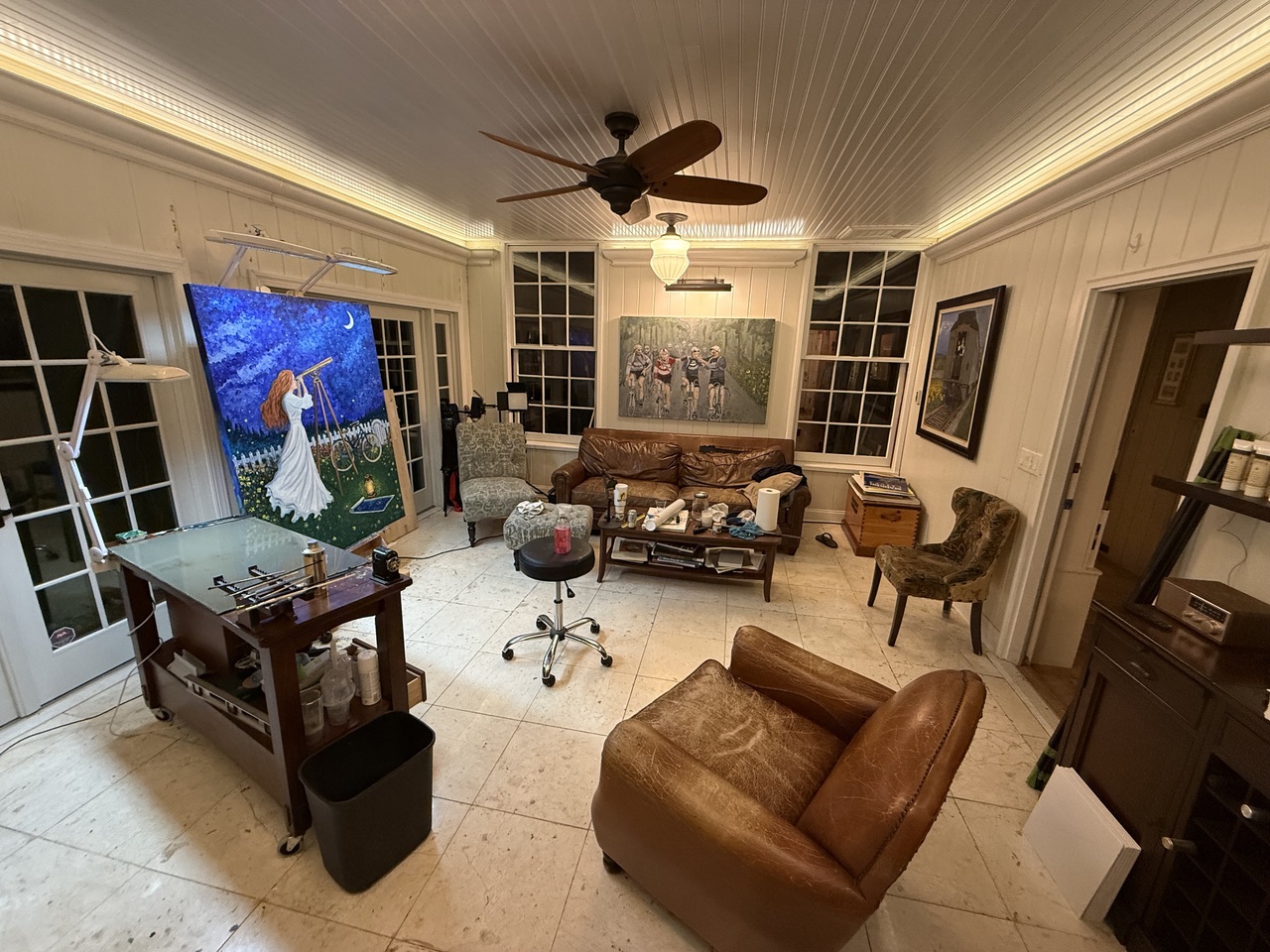
The direction is toward what I think of as vertical integration - a term borrowed from manufacturing but useful here. The idea is simple: as much of the process as possible happens right here in the studio, using raw materials, under my control, from the first decision to the final coat of varnish. By the end of 2026, this will be the way every painting in the Velo Paintings series is made.
The Stretcher
The first change is the most physical one. I am building my own stretcher bars.
A stretcher is the wooden frame over which canvas is pulled and held under tension. Most artists working today buy them pre-made: kiln-dried hardwood strips, mitered corners, ready to assemble in minutes. There is nothing wrong with this. The result is a functional, dimensionally stable support for the canvas, and it works.
But a commercial stretcher is made to standard dimensions. It has no relationship to the specific painting it will eventually carry. When you order a 60 × 48″ stretcher, you get the same frame that ten thousand other painters also ordered. The material has no history connected to the work. The proportions are whatever the catalogue offered.
Building my own means the stretcher for each painting begins as a decision, not a purchase. What species of wood - and why. What corner joint. What profile depth for a canvas of this scale. Whether the bars need to be keyed for future tension adjustment. These are questions that involve thinking about the specific painting before it exists, and that thinking is not wasted.
On the keyed stretcher
Traditional stretcher bars are built with small wedge-shaped keys at each interior corner. Driving the keys in with a hammer pushes the corners outward, increasing the tension of the canvas as it relaxes over time. A properly keyed stretcher can be re-tensioned without removing the canvas. This matters for paintings that will travel, be stored, or live for decades in environments with varying humidity. It is a small detail with long consequences.
Once the stretcher is built, I will stretch canvas in bulk from full rolls rather than buying pre-primed, pre-stretched panels. This means applying my own ground - typically rabbit skin glue sizing followed by oil-based gesso - which gives me direct control over the absorbency and tooth of the surface I will paint on. A surface I sized and primed myself behaves differently under paint than a commercial panel. I know what went into it. I know how it will respond.
The Frame
The second change is one I am most excited about, and it is the one that most changes the nature of the work itself.
The frame for each painting will be designed and built before the painting begins.
This is not how framing typically works. The standard process is to complete the painting, then find a frame that works with it - or have one made to order after the fact. The frame is a post-production decision, a finishing step, something that happens to the painting after it exists.
What I am proposing instead is that the frame is part of the original conception. Before the first mark goes on the canvas, I will have a fully stretched support and a custom-built frame designed specifically for it - for its dimensions, its intended palette, the character of the subject. The frame becomes a collaborator in the design of the work, not an accessory to it.
This changes how I think about a painting before I start it. Holding a stretched canvas next to a frame built for it tells you things about proportions, weight, scale, and presence that you cannot learn from looking at a blank canvas alone. It forces a level of commitment to the end result that changes the nature of every decision that follows.
What the frame says before the painting does
A frame is not neutral. Its width, its profile, its finish - whether it absorbs or reflects light, whether its moulding draws the eye inward or holds it at the border - all of this shapes how a viewer first encounters the work. When the frame is designed in response to a finished painting, it adapts to what already exists. When it is designed alongside the painting, it participates in the decision of what that painting will become. The relationship is different. The conversation goes both ways.
The Paint
The third change is the one that goes deepest.
I am going to stop using manufactured paint and start making my own.
I have written before about the palette I work with - five pigments: Titanium White, Bismuth Yellow, Permanent Alizarin Crimson, Burnt Umber, and French Ultramarine. The choice to work with a limited palette was already a deliberate one, a way of building coherence and discipline into the work. What I have been doing is buying those five pigments in tube form, already ground and suspended in oil by a manufacturer.
What I am moving toward is grinding those pigments myself, in the studio, in linseed or walnut oil, on a glass slab with a muller. This process - called paint making or pigment mulling - is the way all paint was made until the first commercial paint manufacturers appeared in the mid-nineteenth century. Rembrandt ground his own. Vermeer ground his own. Every painter working before roughly 1840 ground their own. The tube of paint is a recent invention, and a convenient one, but convenience is not always the same thing as control.
| 5Pigments in the palette | 1841Year the paint tube was patented | 3Steps: size, prime, paint | 2026Target year of transition |
When you grind your own paint, you control the particle size of the pigment, which affects how it handles and how it dries. You control the oil ratio, which affects the consistency, the sheen, and the long-term stability of the film. You can make a stiff paint for passages that require body and a lean paint for transparent glazes, all from the same pigment ground to different specifications. The tube paint you buy has already made all of these decisions for you.
There are also pigments I want to work with that are not available in commercial tube form - or not in the forms that interest me. Working from dry pigment opens the full range of what is available. Some of the most beautiful pigments in the historical tradition are not produced as artist’s oil paint: certain iron oxides, some of the more unusual earth colours, materials that have been used since antiquity but have no commercial manufacturer producing them for the modern artist’s market. Getting closer to these materials means working with them at the source.
On mulling pigment
The process is older than almost any other technique in painting. Dry pigment is placed on a thick glass or stone slab with a small amount of oil and worked in circular strokes with a glass muller - a hand-sized tool with a flat base - until the pigment particles are fully coated and the mixture reaches the desired consistency. The result is paint with no additives, no stabilisers, no fillers. Just pigment and oil in whatever ratio you choose. The painter’s knowledge lives in their hands: how much pressure, how many passes, what consistency tells you the paint is ready. It is knowledge that can only be built by doing it.
What This Is Really About
I want to be clear that this is not about making things harder or more complicated for its own sake. I am not interested in difficulty as a virtue. What I am interested in is the relationship between the maker and the made thing.
Every layer of distance between a painter and their materials is a layer of distance between the painter and the work. The manufactured stretcher, the commercial canvas, the tube paint - each of these is a decision made by someone else, somewhere else, optimised for the middle of the market. They are adequate solutions. But adequate and right are not the same thing.
When I build the stretcher myself, I know what wood I chose and why. When I size and prime the canvas, I know how it was prepared. When I grind the paint, I know the oil ratio and the particle size and the specific pigment I started with. When the frame is designed before the painting begins, both the frame and the painting know about each other from the start.
This is not a rejection of modernity or a nostalgic gesture toward the old ways of doing things. It is a practical decision about how close I want to be to the work I am making. And the answer is: much closer than I currently am.
The full transition will be in place by the end of 2026. Many of the paintings that complete the Velo Paintings series will be made this way - from a piece of wood, a roll of linen, a handful of dry pigment, and a clear idea of what the painting needs to become. I will share each stage of the process here as it develops.
I am genuinely excited about where this is going. I have no idea yet what some of these changes will produce. That uncertainty is exactly the point.