There is a brief window in the history of art - roughly forty years, running from the mid-1880s to the mid-1920s - when the bicycle was one of the most painted, illustrated, and artistically celebrated objects in the Western world. The work produced in that period represents some of the finest applied art ever made. And almost nobody talks about it.
This is an attempt to change that. And to explain why a fifty-painting oil series made in New Hampshire in 2026 is a direct continuation of that tradition.
Why the 1890s Produced a Golden Age of Cycling Art
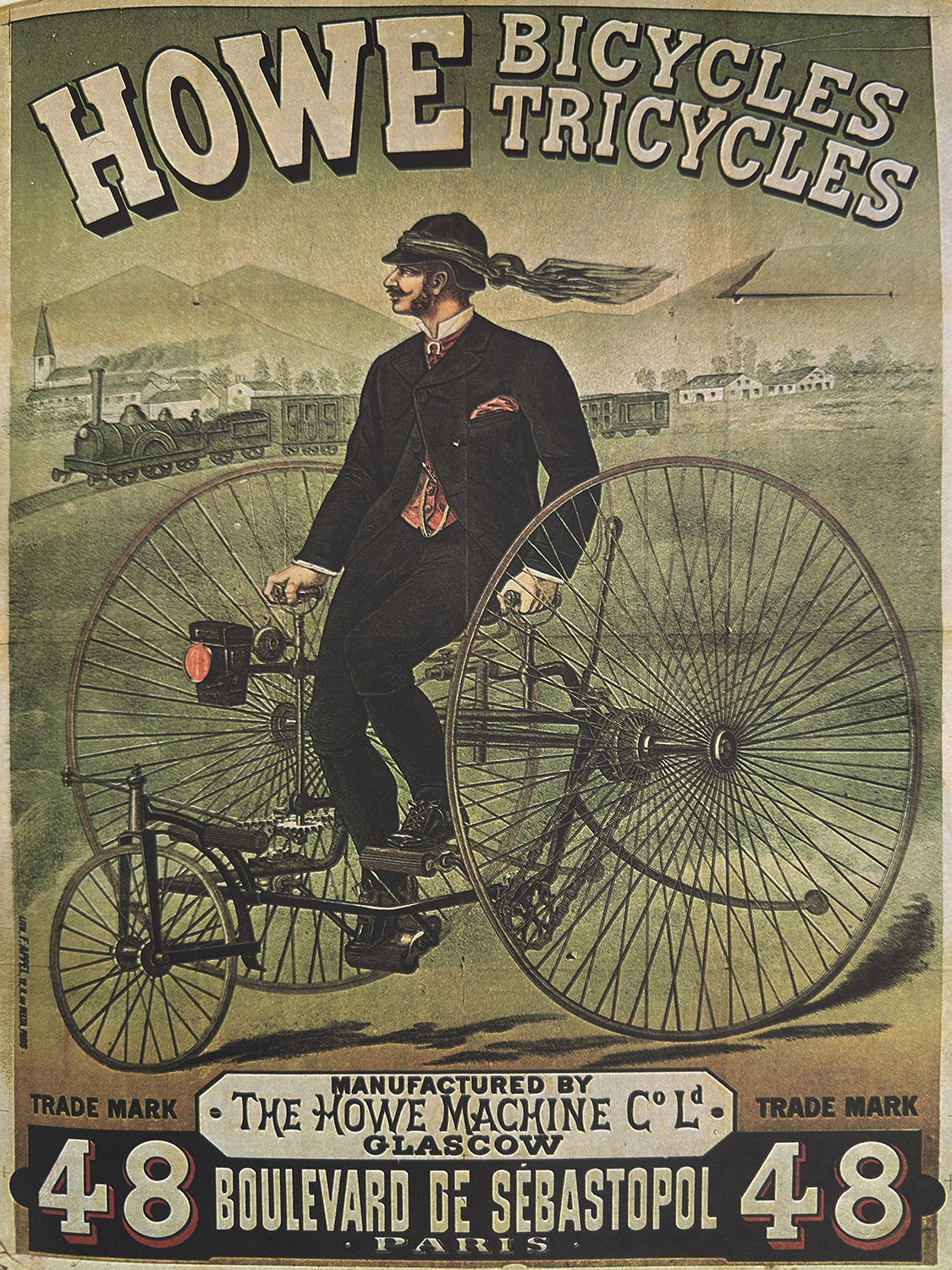
The safety bicycle - the chain-driven, equal-wheeled design that we would still recognise today - arrived in commercially viable form in the late 1880s. Within five years it had triggered one of the most rapid shifts in social behaviour in modern history. By 1895, an estimated four million bicycles were in use in the United States alone. The roads of Europe and North America were transformed. An object that had existed in crude experimental forms for decades suddenly became, practically overnight, the dominant mode of personal transport for the middle class.
This created an economic problem that had an artistic solution. Dozens, then hundreds of bicycle manufacturers needed to reach a market that had not existed five years earlier. They needed to explain what cycling felt like - the freedom, the speed, the independence, the pleasure - to people who had never experienced it. Text could not do this alone. They turned to artists.
What followed was an extraordinary alignment of commercial necessity and artistic talent. The poster art movement was already cresting in Europe, led by Jules Cheret, whose dynamic, colour-saturated lithographic work had transformed the visual language of public advertising. Alphonse Mucha had arrived in Paris from Czechoslovakia and was developing the flowing, organic, heavily decorative style that would define Art Nouveau at its most sophisticated. Eugene Grasset, Henri Privat-Livemont, and a dozen other artists of comparable skill were producing work for theatres, exhibitions, and consumer brands that was genuinely ambitious as visual art.
These were the artists the bicycle manufacturers hired. The budgets were significant. The creative latitude was substantial. The result was a body of historical cycling art that has never been equalled: lithographic posters of extraordinary quality, combining the allegorical ambition of fine art with the communicative urgency of advertising, depicting a world in which the bicycle was not merely a machine but a vehicle for something larger - freedom, aspiration, the transformation of everyday life.
What Made It Art Rather Than Advertising
The best of these works did something that separates art from decoration: they constructed a mythology. The Cycles Gladiator poster of 1905, attributed to Maurice Marodon, showed a winged female figure ascending through a night sky above the curve of the earth. She is not demonstrating a product. She is embodying a feeling - the feeling that on a bicycle, the normal limits of what a human body can do have been renegotiated. The bicycle made her capable of flight.
Mucha's 1898 poster for Cycles Clement and Cie placed the bicycle almost as an afterthought within an elaborate composition of decorative borders, natural forms, and a central figure whose presence makes the product feel almost incidental. The poster was not selling a mechanism. It was selling membership in a world where beauty and movement and independence were available to anyone who could afford a bicycle.
This is the visual language of the golden age of cycling art: allegorical, aspirational, rooted in the natural world, and deeply influenced by the Art Nouveau conviction that beauty and function were not opposites but partners. The best of these posters were collected from the moment they were printed. They were reproduced without permission. They outlasted the companies that commissioned them by a century. Several have sold at auction for six figures.
They were, and are, real art - art that happened to have a brand name printed across the top.
Why the Tradition Faded
The golden age of cycling art ended for several reasons, and they arrived simultaneously. The automobile displaced the bicycle as the aspirational vehicle of the middle class. Photography improved to the point where it could be used effectively in advertising. Printing technology changed, reducing the dominance of the large-format lithograph. And Art Nouveau itself - the visual style most closely associated with this body of work - fell out of fashion with remarkable speed, replaced by the harder lines and geometric discipline of Art Deco and Modernism.
By the mid-1920s, the conditions that had produced the great cycling posters had dissolved. Racing imagery continued - the Tour de France and the Giro d'Italia provided drama worth depicting - but the grand allegorical tradition of the 1890s and 1900s was over. Cycling art became sport art: riders on climbs, pelotons on cobblestones, the specific and literal rather than the mythological and emblematic.
What was lost was the idea of the bicycle as a symbol of something larger than sport. The machine that had genuinely transformed daily life for millions of people, that had given women their first taste of independent mobility, that had been celebrated by the best artists of the age as an instrument of human aspiration - that bicycle disappeared from art at precisely the moment when the automobile arrived to claim the same symbolic territory.
The great cycling posters remained. But the tradition of making them had been broken.
The Gap - and What Filled It
For most of the twentieth century, cycling art meant one of two things: race photography, and the occasional contemporary painter working the peloton as a subject. Both are legitimate. Neither reconnects to the deeper tradition of the golden age.
Race photography is documentary. It records what happened. It is governed by the requirements of accuracy and timing. The best cycling photographs are extraordinary works, but they are constrained in what they can mean by the obligation to record the specific: this rider, this road, this moment.
Contemporary cycling paintings have largely followed photography's lead - depicting races, known riders, famous climbs. Some of this work is technically accomplished. But the allegorical ambition of the great Art Nouveau cycling posters - the willingness to use the bicycle as a vehicle for exploring larger ideas about freedom, aspiration, the human relationship with speed and landscape - has rarely been recovered.
The historical cycling art of the 1890s and 1900s has not had a serious successor.
The Golden Age Series - A Fifty-Painting Continuation
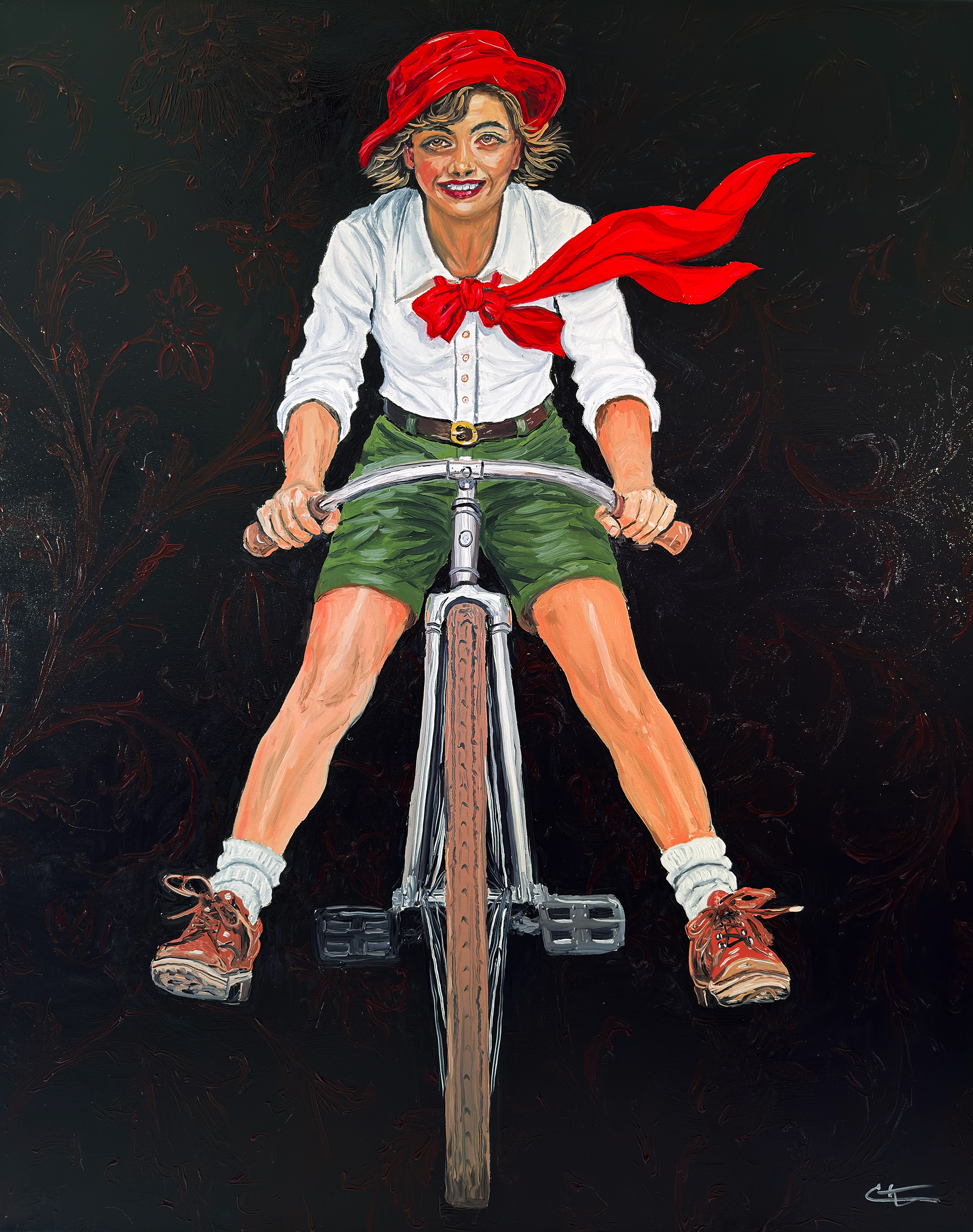
The Golden Age Series is an attempt to pick up that thread. Not to reproduce the original posters, or to work in pastiche, but to understand what the great cycling artists were actually doing and to do it again in oil paint - with the commercial text stripped away and the image allowed to mean what it was always trying to mean.
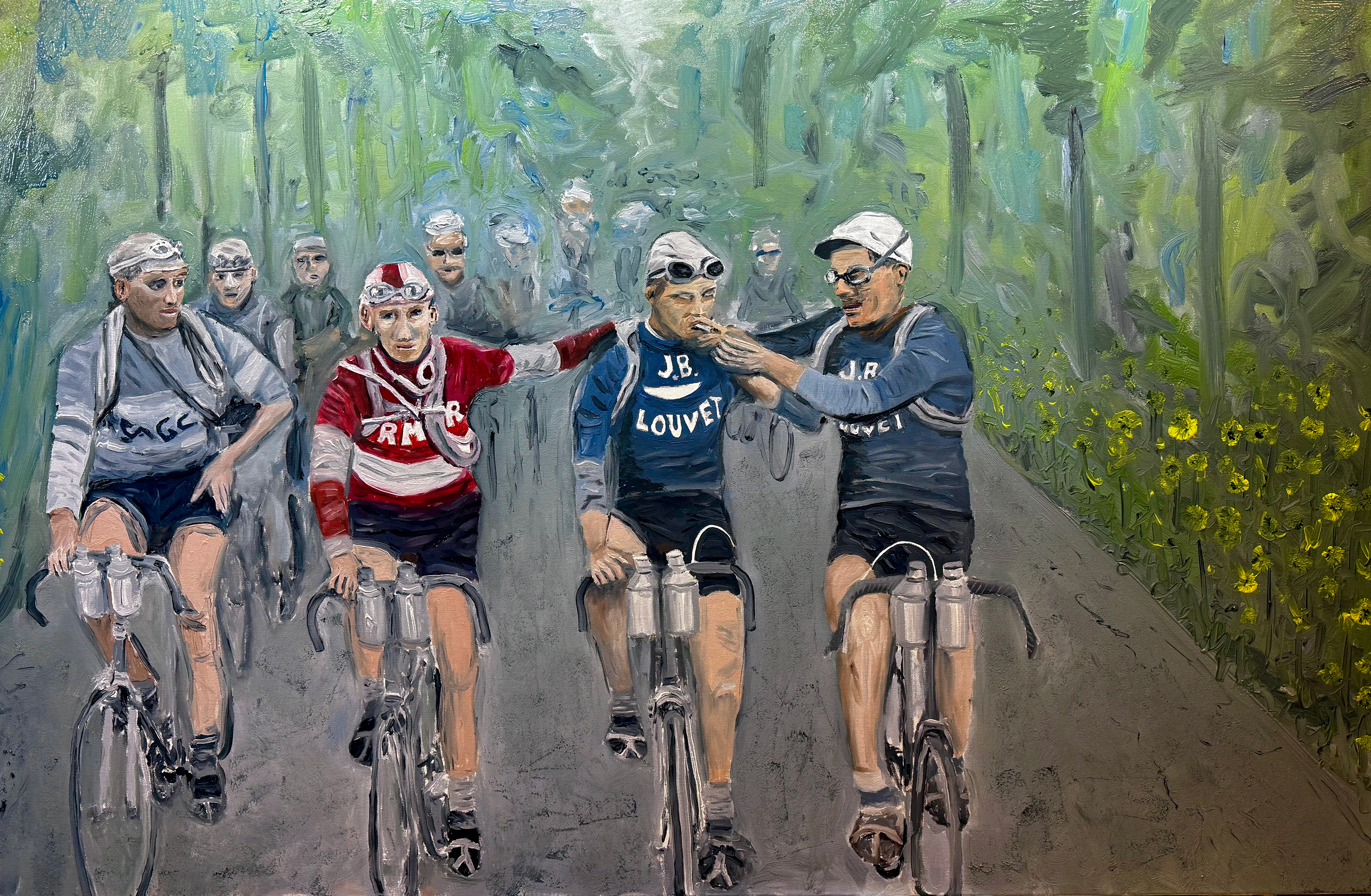
The series covers the period from roughly 1800 to 1930 - the same forty years that produced the original golden age. But it approaches that era through the full range of its experience, not only the race podiums. Luna works directly in the tradition of the allegorical cycling poster, placing a winged figure atop the globe beneath a crescent moon - the kind of image Marodon or Mucha might have made, rendered in oil on canvas with every word removed. The Three Sisters draws on the women's cycling advertising of the 1890s and the real social history of the bicycle as an instrument of women's liberation. The 1927 Tour de France depicts the race at its most elemental - steel bicycles, unpaved roads, a rider who would finish alone after his teammate's bike shattered on a mountain stage.
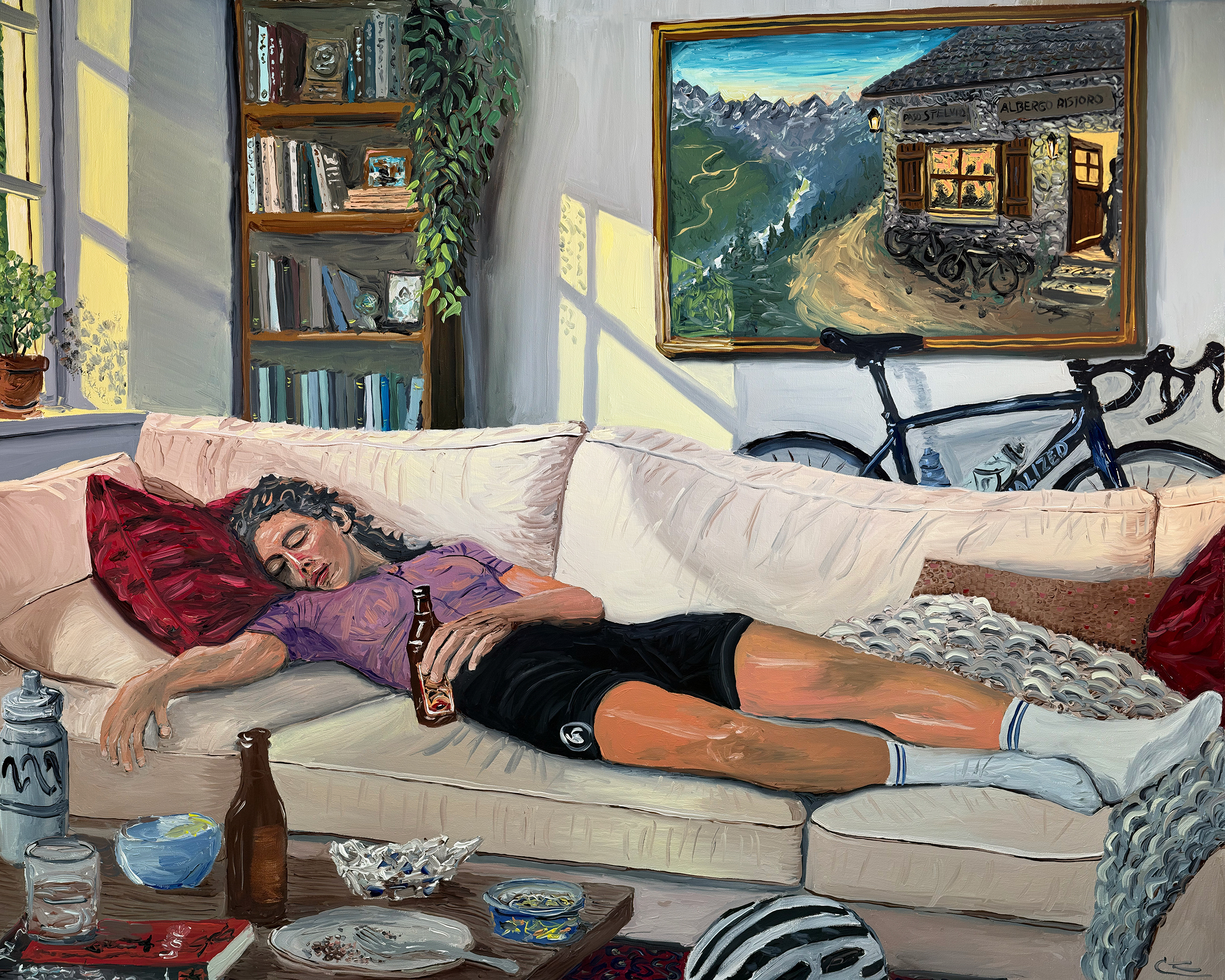
Each painting in the series is in conversation with the historical cycling art of the period it depicts. Some of those conversations are explicit - direct responses to specific poster traditions or historical moments. Others are more atmospheric: the visual language of the era absorbed and translated into oil paint, into the particular qualities of brushwork and surface and light that photography and lithography cannot achieve.
Fifty paintings is not an arbitrary number. It is the scope required to do justice to the breadth of the period - to cover the race history and the social history, the European tradition and the American one, the allegorical and the documentary, the riders whose names are remembered and the ones who have been forgotten. When the series is complete, it will be the most sustained engagement with the visual culture of the golden age of cycling that exists in oil paint.
Why Oil Paint, and Why Now
The original cycling posters were lithographic prints - a medium ideally suited to the bold colour fields and flat decorative surfaces of Art Nouveau. Oil paint does different things. It accumulates. It has physical presence. A brushstroke in oil paint carries the record of the gesture that made it, the pressure and speed and direction of the painter's hand. It ages differently from print. It occupies a room differently.
Choosing oil paint for this series is a deliberate statement about what these images are. They are not reproductions of a print tradition. They are original works, made by hand, one canvas at a time, by an artist who has spent thirty years riding the roads that the subjects of these paintings rode. The historical knowledge is direct - not from books alone but from the body's memory of what a long climb feels like, what a headwind does to your sense of time, what it means to find cold water at a roadside fountain on a hot afternoon.
That embodied knowledge is what separates the Golden Age Series from historical illustration. The paintings know what they are depicting from the inside.
Where the Series Stands
The series is currently nine paintings deep, with new works completing at roughly weekly intervals. The paintings span the full range of the series' ambition: allegorical and documentary, race history and social history, European Alps and American nights, riders known and unknown. Each is accompanied by a long-form essay exploring the historical and artistic context of the work - the kind of writing that allows a viewer to understand not just what the painting shows but what it means and why it was made.
The originals are available for private inquiry. Fine art archival prints of each painting are available through the Velo Paintings print shop in multiple sizes on museum-quality archival paper and canvas. For anyone who cares about the history of cycling as a visual subject - and about what serious oil painting can do with that history - the series is the most sustained engagement with the golden age of cycling art being made anywhere today.
It began with a gap in the tradition. It is filling that gap, one painting at a time.