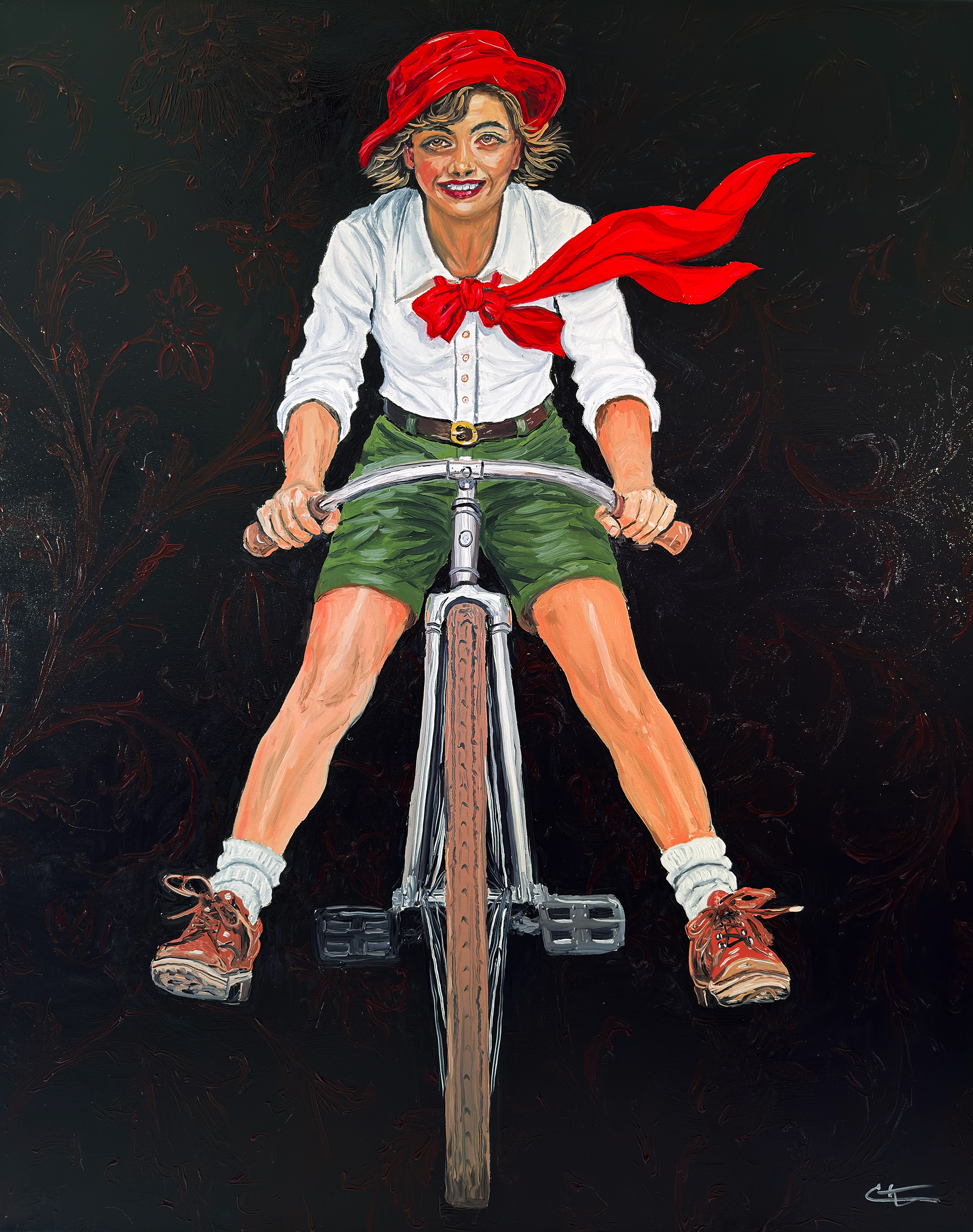
The Golden Age of Cycling, Painting No. 11 of 50
Think back to the first time a bicycle truly carried you. The wobble, the push, the sudden terrifying wonderful realization that no one was holding on anymore, and then the world tipping into motion beneath you. For most of us that memory lives in childhood, filed away with scraped knees and summer evenings. But here’s the secret every rider eventually learns: that feeling never actually leaves. It just waits for the next time you get on a bike.
The eleventh painting in our Golden Age of Cycling series is about exactly that. It’s called Pure Joy, and it shows a young woman riding out of the dark, lit by a smile she isn’t trying to hide. There’s no race here, no rival, no clock. Just the open road and the weightless happiness of being on two wheels. She is the same joy a child feels on a first bicycle, grown up, and undimmed.
The first machine that set us free
To understand why the bicycle inspires this feeling, it helps to remember what it actually did. When it arrived, the bicycle was the first machine that let ordinary people go where they wanted, when they wanted, entirely under their own power. No horse to keep, no fare to pay, no permission to ask. For millions of people, and famously for women, who found in the bicycle a freedom the era rarely offered them, it redrew the boundaries of a single afternoon. A village was no longer the edge of the world. The next town was suddenly within reach.
That is the deep current running beneath the whole Golden Age of Cycling, and it’s what Pure Joy puts front and center. The woman in the painting isn’t trying to beat anyone. She’s free, and she knows it, and that knowledge is written all over her face.
Joy that doesn’t check your age
We’re quick to hand the joy of cycling to children. The training wheels, the first solo lap of the cul-de-sac, the bike left lying in the grass at dusk, these are the images we reach for. But the bicycle is gloriously indifferent to how old you are. The same lightness that thrills a seven-year-old is waiting on the morning commute, on the long Sunday climb, on a borrowed bike in an unfamiliar city, on the route you’ve ridden a thousand times and somehow still love.
That’s the heart of Pure Joy. By giving us a grown woman wearing the unmistakable delight we usually reserve for kids, the painting makes a quiet argument: the feeling created by riding a bicycle is just as strong and vibrant at an older age. It doesn’t fade with time. It doesn’t belong to one kind of person. Cycling asks nothing about your background or your years, only that you push off and go. The joy is the same joy a child feels on a first bike and the same joy a grandparent feels rediscovering one. It is, in the truest sense, for everyone.
A tip of the hat to a masterpiece
Pure Joy carries a deliberate echo of one of the most beautiful cycling images ever made. In 1916, the Italian poster artist Plinio Codognato painted a small boy on a bicycle for Pirelli, coasting toward the viewer out of a famously bold, solid-black background, an image with eyes you genuinely cannot resist. It sold the wonder of a child’s very first bike, and it remains a touchstone of cycling art more than a century later.
This painting answers that one across the years. Same light emerging from the same darkness, but the rider has grown up, and the feeling has not. Where Codognato captured the beginning of a lifelong love affair with the bicycle, Pure Joy captures its enduring middle: the moment you realize the happiness you felt as a child was never something you’d outgrow.
There’s one more thread tying the two together. Look at what she’s wearing: green, white and red, the colors of the Italian flag, a nod to Pirelli, the Italian company behind the 1916 original. But that’s where the resemblance ends. There’s no advertising in this painting, no brand, no product to sell. The company has fallen away and only the colors remain, carried forward not as a logo but as a small, affectionate tribute to where the image began.
Why it belongs in the fifty
Every painting in this series captures something essential about the years when the bicycle changed how people lived and dreamed. Pure Joy earns its place by naming the simplest truth of all, the reason any of us ever fell in love with cycling in the first place. Strip away the champions and the grand tours and the records, and what’s left is a person, a bike, and an open road. Freedom you can pedal. Joy that never grows up. That’s painting No. 11.
No. 11 of 50, The Golden Age of Cycling. Pure Joy. Inspired by Pneus Pirelli (Plinio Codognato, 1916).