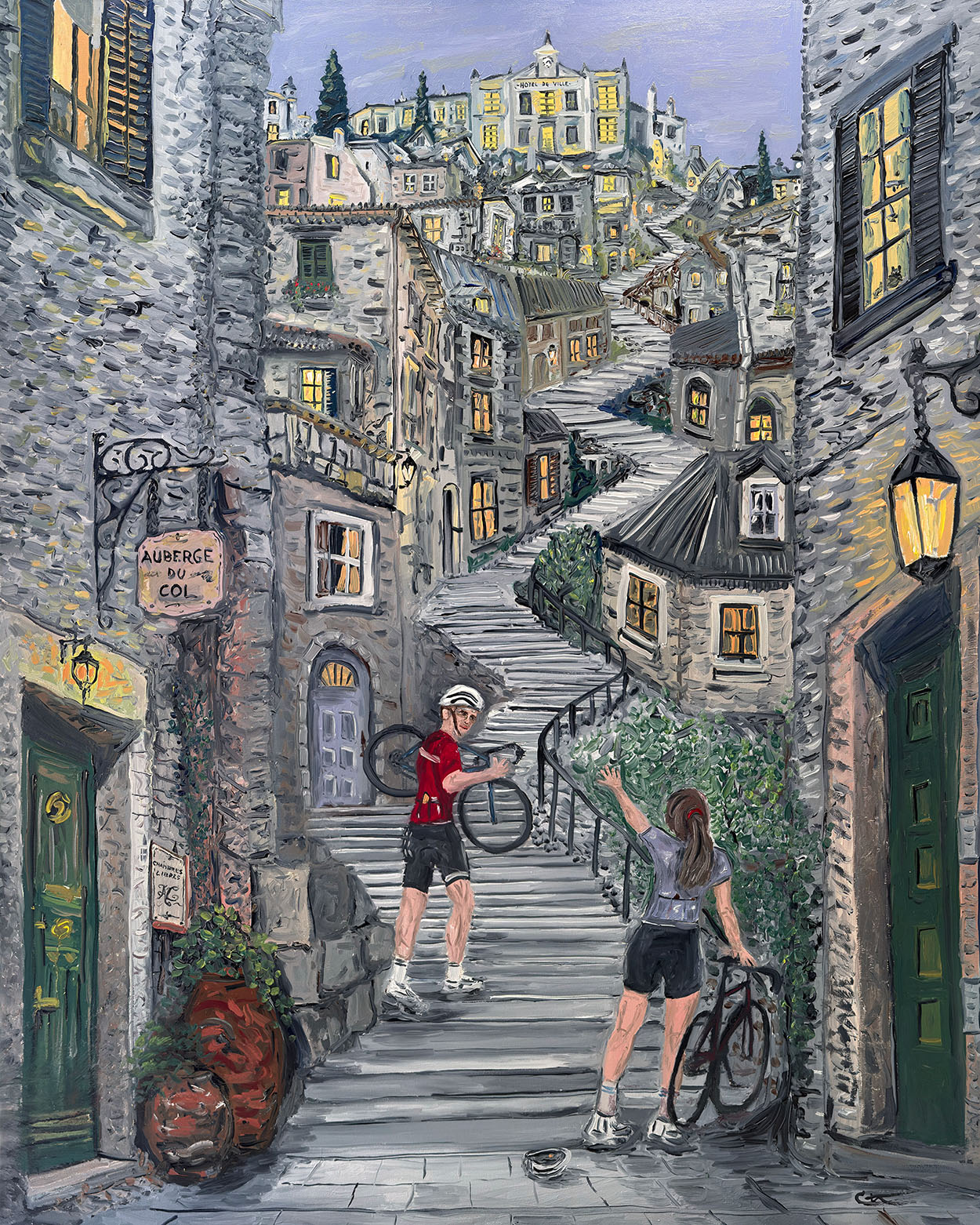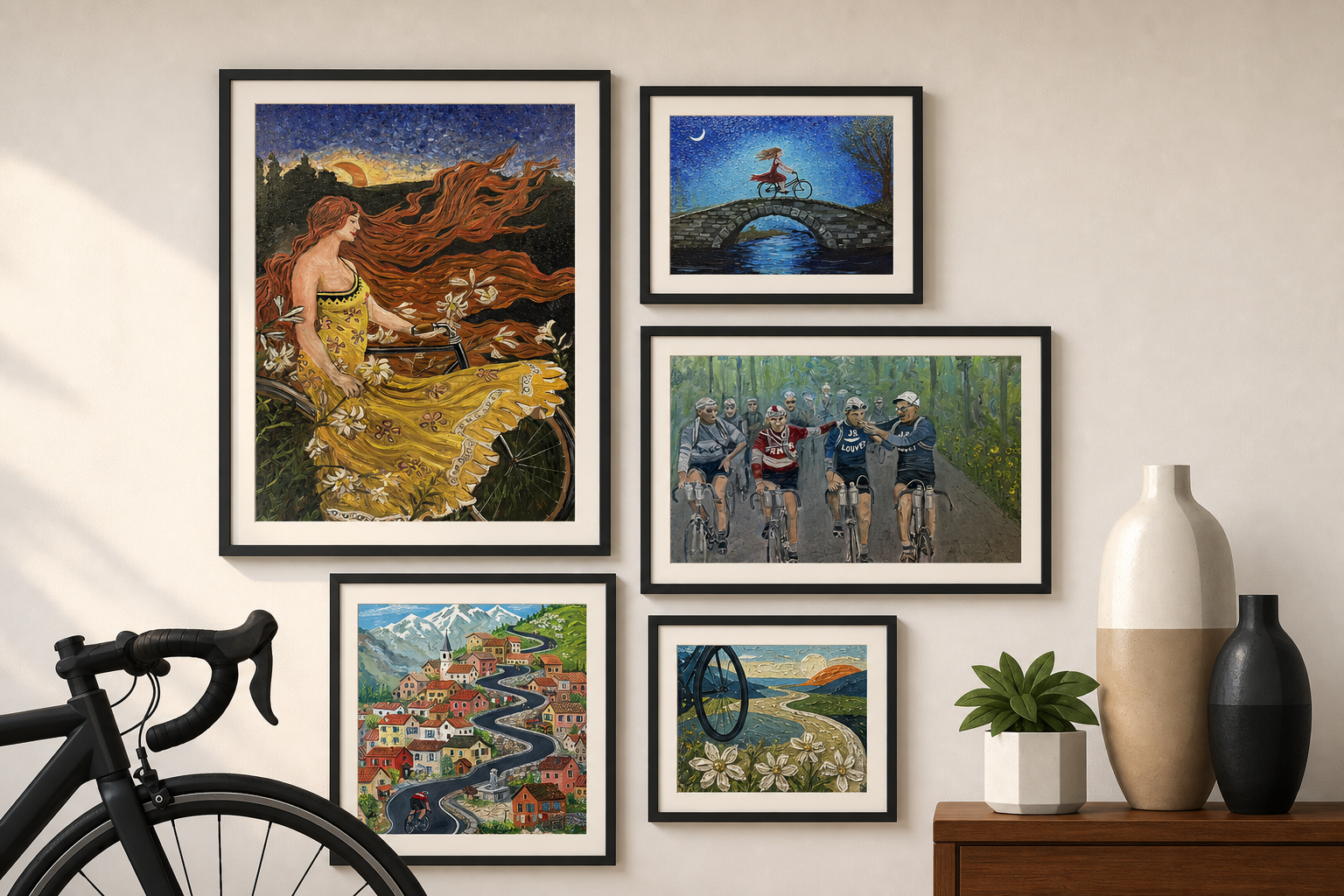
A bicycle leaning against a sun-warmed café wall, a lone rider cutting across an Alpine pass, the faded geometry of a race number - these are more than cycling references. The right fine art prints preserve the feeling behind them: the long road, the quiet preparation, the old machinery, and the sense that a ride can become a memory before it is over.
For collectors, the distinction matters. A print should not simply fill an empty wall or announce an interest in bicycles. It should hold attention over time, carrying the visual weight, authorship, and atmosphere that make an original painting worth returning to. Choosing one well is partly a question of materials and framing, but it begins with a more personal question: what part of cycling’s history or emotional landscape belongs in your home?
Fine Art Prints Begin With an Artist’s Vision
A fine-art print is an authored reproduction of an original work, made with close attention to color, detail, paper, and permanence. That sounds straightforward, yet the gap between an art print and ordinary wall décor can be considerable.
A generic cycling poster may offer a recognizable bicycle, a famous route, or a bold slogan. It is designed for immediate effect. A print made from an original oil painting has a different purpose. It carries forward the artist’s decisions: the compression of distance in a road scene, the softened edge of a jersey in motion, the particular color of a late-afternoon sky. Those decisions give a work its point of view.
For an enthusiast, that point of view is often where the connection lies. Cycling has always had a visual culture of its own - hand-painted signs, wool jerseys, weathered steel frames, roadside shadows, and the ceremonial drama of the grand tours. Art that understands this language can feel familiar without becoming nostalgic in a shallow way. It respects the bicycle as an object of craft and the road as a setting for human effort.
This is also why a print does not need to depict a rider you know, a race you attended, or a bike you once owned. A strong image leaves enough room for your own associations. The best works suggest a story rather than illustrating every part of it.
Choosing Fine Art Prints With Lasting Presence
Begin with the image, not the room. It is tempting to choose art by palette alone, especially when furnishing a new office, studio, or living space. Color matters, but a picture selected only because it matches a chair or wall color can lose its appeal once the room changes.
Instead, live with the subject for a moment. Does the work recall the solitary rhythm of early-morning rides? The spectacle and pageantry of historic racing? The formal beauty of a classic frame? A road disappearing toward a horizon? The answer will help determine whether the print has personal staying power.
Scale is the next decision, and it is more consequential than many collectors expect. A small print can be intimate and concentrated, especially in a study, hallway, or beside a desk. It invites close looking. A larger print gives the scene room to breathe and can establish the character of a living room, dining room, or dedicated cycling space.
Before ordering, mark the proposed dimensions on the wall with painter’s tape. Stand back at the normal viewing distance, then sit in the room and look again. A print above a sofa or sideboard generally needs enough width to feel intentional rather than incidental. On the other hand, an oversized work in a narrow room may overwhelm the architecture and flatten the quiet poetry of the image.
The amount of visual activity in the work should guide the choice, too. A dense peloton scene, with figures, wheels, and road markings, can reward a generous scale. A restrained painting of a bicycle against an open landscape may gain power from space around it. It depends on the composition, not simply the available wall.
Consider the emotional temperature of the room
A home office may suit a work with energy and forward motion, while a bedroom may call for a quieter road scene or a still life centered on a bicycle’s elegant details. Neither approach is better. The aim is to let the art deepen the room’s atmosphere rather than compete with it.
Cycling art also works especially well in places where the passion is already present: a workshop, training room, mudroom, or the wall above a collection of helmets and old race photographs. Yet it need not be confined to those spaces. A finely observed landscape or evocative race scene belongs just as naturally among books, wood furniture, and collected objects in a more formal room.
Materials That Respect the Artwork
Once the image is chosen, materials determine how faithfully it will live on the wall. Museum-quality pigment printing, often called giclée printing, is valued for its nuanced color and tonal range. When paired with an archival paper or canvas, it can reproduce the subtleties that are easily lost in lower-grade reproduction: the grain of a painted road, the depth of cloud cover, the layered color of an oil-painted jersey.
Paper has its own character. A matte, textured fine-art paper often feels especially appropriate for work based on oil painting because it avoids a highly commercial sheen and gives the image a tactile, composed presence. A smoother paper can make sharper lines and brighter color feel more immediate. Neither is universally right. The subject and the artist’s intended finish should lead.
Ask how the print is made, what paper or canvas is used, and whether the materials are archival. If a work is offered as a limited edition, understand what that means: the total number produced, whether it is signed or numbered, and whether a certificate accompanies it. Limited editions can add a sense of collectibility, but the edition size alone does not create artistic value. The image, its authorship, and the quality of production matter first.
An open edition can still be a beautiful and thoughtful acquisition, particularly when the goal is to bring an artist’s work into daily life at a more accessible price. A limited edition may be the better fit for a collector building a focused group of works over time. There is room for both.
Framing Is Part of the Viewing Experience
A frame should support the work without turning it into an accessory. For cycling art rooted in the golden age of the sport, natural oak, walnut, or a restrained black frame often provides a lasting foundation. These choices acknowledge the material warmth of older bicycles and the quiet utility of traditional craftsmanship.
White mats can give a smaller print more air and make it feel more formal. A float mount can emphasize the paper’s edge and lend a contemporary gallery character. For a large landscape, a narrow frame with little or no mat may allow the scene to retain its sweep. The right choice depends on the image and the surrounding room.
Glazing deserves careful consideration. Standard glass is serviceable, but it can catch reflections from windows and lamps. Museum glass or high-quality acrylic reduces glare and offers ultraviolet protection, which is especially useful in bright rooms. No print should hang in direct, sustained sunlight, even when archival materials are used. The goal is not to make art precious and untouchable, but to give it a long, stable life.
If you are grouping a print with other pieces, avoid forcing everything into identical frames and sizes. A collected wall gains character from thoughtful variation. Let a cycling print converse with an old map, a black-and-white family photograph, a landscape, or a piece of handmade ceramics nearby. Shared tone and proportion matter more than perfect symmetry.
Let the Work Earn Its Place
Fine art has a way of becoming part of a household’s private vocabulary. A visitor may notice a painting or print because of the bicycle, but the lasting conversation often turns to a favorite road, an old race, a first long ride, or the pleasure of a machine made with care.
Choose a work that offers more than recognition. Look for one that carries movement, weather, history, and a little mystery. Give it proper scale, considered framing, and a place where it can be seen in the unhurried moments of ordinary life. Over time, the print may become less like decoration and more like a window onto the road.